May 05, 2013

Jon English: Long Cool Woman In A Black Dress...And A Bonus Track From "Laid" - "Maybe I'm Amazed"


This solo gem by Jon English from the studio album "Laid", was recorded in 1972.


It’s probably my favourite of all the tracks although I think this entire vintage Australian rock album is excellent!

More information here.
The group, Duck, comprised of:


Larry Duryea (percussion)
Jon English (vocals)
Bobby Gebert (piano)
Bobbi Marchini (vocals)
Danny Robinson (vocals)
John Robinson (guitar)
Russell Smith (guitar)
Teddy Toi (bass)
Steve Webb (drums)

The song was written by by Allan Clarke, Roger Cook, and Roger Greenaway and was first performed by the British pop group The Hollies

There is also a very good version by Raul Malo which was recorded or performed much later, and has a distinct country flavour as Raul Malo is (again) part of the group, The Mavericks.

                                                                   
I have a few rare tracks by Jon English on this blog and they can be found by using the Blogger search function: top left.


Bonus: Jon English  sings "Maybe I'm Amazed" from the same album.


"Maybe I'm Amazed" is a song written by Paul McCartney.


It was first released in April 1970. He wrote it before the Beatles split, and also as a dedication to his then wife, Linda.

Another solo by Jon English from “Laid” – Lucille Has Messed My Mind Up – is here.

Duet “Anyway That You Want Me” by Jon English and Bobbi Marchini from “Laid” can be watched here.


 Some stills from an interview Jon did.


Other songs by Jon English on this blog - a summary:

Jon English Sings "Waterloo".
Jon English Sings "Behind Blue Eyes".
Countdown Celebrates Its 40th Anniversary: Prince Charles Recreates The Interview With Molly Meldrum

♥♥Remembering Jon English♥♥
          
                                                                  
Many thanks to Garry for this picture.Click to enlarge.


Related: G.Wayne Thomas - Morning Of The Earth And Open Up Your Heart


Lost City of Heracleion Gives Up Its Secrets


For centuries it was thought to be a legend, a city of extraordinary wealth mentioned in Homer, visited by Helen of Troy and Paris, her lover, but apparently buried under the sea. 


In fact, Heracleion was true, and a decade after divers began uncovering its treasures, archaeologists have produced a picture of what life was like in the city in the era of the pharaohs. 
The city, also called Thonis, disappeared beneath the Mediterranean around 1,200 years ago and was found during a survey of the Egyptian shore at the beginning of the last decade. 
Now its life at the heart of trade routes in classical times are becoming clear, with researchers forming the view that the city was the main customs hub through which all trade from Greece and elsewhere in the Mediterranean entered Egypt. 

They have discovered the remains of more than 64 ships buried in the thick clay and sand that now covers the sea bed. Gold coins and weights made from bronze and stone have also been found, hinting at the trade that went on. 

Giant 16 foot statues have been uncovered and brought to the surface while archaeologists have found hundreds of smaller statues of minor gods on the sea floor.
Slabs of stone inscribed in both ancient Greek and Ancient Egyptian have also been brought to the surface. 

Dozens of small limestone sarcophagi were also recently uncovered by divers and are believed to have once contained mummified animals, put there to appease the gods.

Dr Damian Robinson, director of the Oxford Centre for Maritime Archaeology at the University of Oxford, who is part of the team working on the site, said: “It is a major city we are excavating. 

“The site has amazing preservation. We are now starting to look at some of the more interesting areas within it to try to understand life there.
“We are getting a rich picture of things like the trade that was going on there and the nature of the maritime economy in the Egyptian late period. There were things were coming in from Greece and the Phoenicians. 


“We have hundreds of small statues of gods and we are trying to find where the temples to these gods were in the city. 

“The ships are really interesting as it is the biggest number of ancient ships found in one place and we have found over 700 ancient anchors so far.” 

The researchers, working with German TV documentary makers, have also created a three dimensional reconstruction of the city. 

At its heart was a huge temple to the god Amun-Gereb, the supreme god of the Egyptians at the time. 

From this stretched a vast network of canals and channels, which allowed the city to become the most important port in the Mediterranean at the time. 

Last month archaeologists from around the world gathered at the University of Oxford to discuss the discoveries starting to emerge from the treasures found in Heracleion, named for Hercules, who legend claimed had been there. 

It was also mentioned fleetingly in ancient texts. 

Dr Robinson said: “It was the major international trading port for Egypt at this time. It is where taxation was taken on import and export duties. All of this was run by the main temple.” 

Submerged under 150 feet of water, the site sits in what is now the Bay of Aboukir. In the 8th Century BC, when the city is thought to have been built, it would have sat at the mouth of the River Nile delta as it opened up into the Mediterranean. 

Scientists still have little idea what caused the city to slip into the water nearly 1,000 years later, but it is thought that gradual sea level rise combined with a sudden collapse of the unstable sediment the city was built on caused the area to drop by around 12 feet. 

Over time the city faded from memory and its existence, along with other lost settlements along the coast, was only known from a few ancient texts. 

French underwater archaeologist Dr Franck Goddio was the first to rediscover the city while doing surveying of the area while looking for French warships that sank there in the 18 century battle of the Nile. 

When divers began sifting down through the thick layers of sand and mud, they could barely believe what they found. 

“The archaeological evidence is simply overwhelming,” said Professor Sir Barry Cunliffe, an archaeologist at the University of Oxford has also been taking part in the excavation. 

“By lying untouched and protected by sand on the sea floor for centuries they are brilliantly preserved.” 

The researchers now also hope that they may even find some sarcophagi used to bury humans in some of the outlying areas around the sunken city. 

“The discoveries enhance the importance of the specific location of the city standing at the 'Mouth of the Sea of the Greek’,” said Dr Goddio, who has led the excavation. 

“We are just at the beginning of our research. We will probably have to continue working for the next 200 years for Thonis-Heracleion to be fully revealed and understood.” 


* Egypt’s Sunken City/ A Legend Is Revealed is to be shown on the German television station Arte on Saturday 11 May at 8.15pm
 
With many thanks to The Telegraph
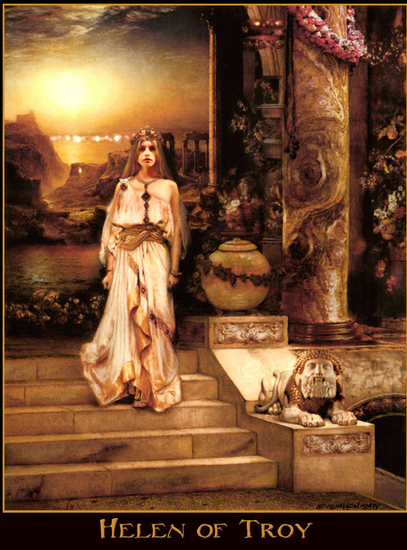
Picture credit “Helen of Troy”: Eclectic/Eccentric

                                                          
click to enlarge. 

See also Helen of Troy - The Movie, The Music and Jon English - if you are not familiar with this story of Helen and Paris. 


See also:

Tuthmosis-era Temple Found Under Egyptian House 


China's Lost Civilization: The Mystery Of Sanxingdui
Symbolic Tomb of Egyptian God Osiris Found
Some Rare and Important Archaeological Finds
Easter Island: Scientists Are Closer To Understanding What Wiped Out Its Society
Largest Trove of Gold Coins Ever Discovered In Israel By Divers
Relief of Queen Nefertiti
Gold Treasures Discovered in Ming Dynasty Tomb 
Unique Mosaic Images Uncovered in Fifth-Century Synagogue
Philip of Macedonia, Greece’s Ancient King, Found
Queen Nefertiti: Was She Hidden In King Tutankhamun’s Tomb? 
England’s Lost Colonists ‘Went Native’ In America
The Cave of Altamira and Paleolithic Cave Art of Northern Spain
The Antikythera Mechanism: Second Expedition Seeks More Mechanism Remains 
 Discovery Of Ancient Cave Paintings In Petra
Scientists Find ‘Superhenge’ That Could Be Five Times The Area Of Stonehenge
Rome Reborn – An Amazing Digital Model of Ancient Rome
A Day in Pompeii 
King Tut’s Egyptian Tomb May Hide Queen Nefertiti 
Ippolito Rosellini: The Monuments of Egypt And Nubia
The Holigost: 600 Year Old Pride of Henry V’s Fleet May Have Been Found
Gem-Filled Warrior's Tomb Discovered in Ancient Greek City
Amenhotep’s Fragmented Book Of The Dead Found 
Acra: Ancient Citadel Unearthed In Jerusalem 
Glastonbury Legends, King Arthur’s ‘Grave’, Made Up For Cash By Monks 
Is Queen Nefertiti Buried In King Tutankhaman’s Tomb? - Latest News
King Hezekiah's Seal Impression Found
Spanish Galleon San Jose Discovered Laden With Treasure Off Colombia 
Has The Lost Island Of Kane Been Found?
'Britain's Pompeii' Found at Bronze Age Settlement  
Babylonians Tracked Jupiter with Fancy Math, Tablet Reveals 
New Clues to Ancient Roman Art Discovered in Egyptian Mummy Portraits
Hidden Rooms In King Tut’s Tomb May Contain Organic Material 
Ancestral Puebloans Were Hit By Boom and Bust
Bible Breakthrough Found In Israel
Queen Hatshepsut's Building Blocks Discovered


May 01, 2013

William Shakespeare: The World As He Made It


There is no doubt that  William Shakespeare was an enormously gifted man whose contributions to Western Culture cannot be truly measured.

The fact that after four and a half centuries we still read,listen to and watch his works is but a small measure of his achievements.

He added so many words to our vocabulary and language, as well as transporting us to a variety of historical scenes and events - actual or fiction.

The article below reads almost like a who’s who of stage and film icons.

Whether it was actually William Shakespeare or another nobleman who wrote all this is a mystery that may never be solved. But does it really matter? Probably not.

Whilst at high school I studied “Julius Caesar”, “Macbeth” and “King Lear”, as well as poems and other scenes from his plays. 

I was also very fortunate to see “The First Four Hundred Years” on stage with Keith Michell and Googie Withers which was touring Australia a long time ago.

Watching a Shakespearean play makes for much easier understanding than simply reading it.

I really enjoyed the movie with Marlon Brando (above), but I especially liked the Franco Zeffirelli movies: “Romeo and Juliet” and “The Taming of the Shrew”. 

The actors – Richard Burton, Elizabeth Taylor, Leonard Whiting and Olivia Hussey were excellent, and the set design and costumes were beautiful!


IT'S 4 1/2 centuries since Shakespeare was born at Stratford in England and still we remain enthralled by the work of this playwright, who is also our language's greatest poet. He created some of the starkest and most terrible images the mind knows. 
Think of Lear's "Howl, howl, howl, howl!" with the dead body of his daughter Cordelia in his arms. Think of Othello, knowing he has killed Desdemona, the woman he has loved. Hamlet encounters a ghost who charges him with a duty he comprehends as little as he does himself. Macbeth and Lady Macbeth are murderers, and yet the play they dominate is one of the most intimate portraits of marriage the world has seen.

We inherit Shakespeare as a birthright with the English language; because of that he becomes part of our minds from childhood. It's not for nothing that Charles and Mary Lamb produced their Tales from Shakespeare and later writers, such as Leon Garfield, retold his plays as enthralling stories for young minds.

So Puck puts a girdle round the earth, and Oberon says darkly to his recalcitrant queen, "Ill met by moonlight, proud Titania."

From where did Shakespeare get Bottom and those mechanicals? Were they dreamt up from his experience in Stratford? Were they suggested by carpenters who worked in his theatres? In any case this story of lovers lost in a wood, and of a loud-mouthed weaver who is given an ass's head so that the queen of the fairies will fall in love with him, is as old and enchanted as childhood.

Some people will have stumbled on Max Reinhardt's 1935 film with Mickey Rooney as Puck and Jimmy Cagney as Bottom before they knew what Shakespeare's words meant. Later, they might have seen the legendary Peter Brook production in the early 70s, set in a bare space with the language providing the enchantment. 

Or, 20-odd years later, the ravishing, highly coloured, Royal Shakespeare Company production by Adrian Noble which toured here. You can get the DVD, with Lindsay Duncan as Titania and Alex Jennings as Oberon. Then again, for a couple of hundred dollars you can pick up the complete BBC Shakespeare on DVD, which includes A Midsummer Night's Dream with a young Helen Mirren as Titania.

The point is that Shakespeare is part of the air we breathe. We come across The Merchant of Venice with its casket myth, with wicked Shylock and Portia preaching, with the quality of mercy; it has something of the cruelty and mysterious weirdness of a fairy story. It's only later that we ponder Shylock's "Hath not a Jew eyes?" or listen to the depth of poignancy when he hears of his daughter, Jessica, running away. She exchanged a ring of his for a monkey: "It was my turquoise; I had it of Leah when I was a bachelor. I would not have given it for a wilderness of monkeys."

There is a recording of Michael Redgrave playing Shylock with a German Yiddisher accent and with a towering heroic tragic grandeur. Laurence Olivier played him in the put-on posh voice with which self-made Londoners used to disguise their social origins. The nearest port of call for a kid wanting to encounter the play might be the film with Al Pacino as an intense New York Jewish Shylock, a performance he repeated on the stage in Central Park.

It should be clear that Shakespeare belongs to that fundamental part of our culture in which popular and classical meet. It wasn't long after his Stanley Kowalski in the film of Tennessee Williams's A Streetcar Named Desire that Marlon Brando, the man who reinvented the idiom of modern acting, played Marc Antony in Joseph Mankiewicz's film Julius Caesar (with James Mason as "the noblest Roman of them all", Brutus, and John Gielgud as the "lean and hungry" Cassius).

As a child I remember my father telling me that Brando had delivered that greatest of all political speeches, "Friends, Romans, countrymen, lend me your ears", like a wharfie. He does. In Brando's hands, it's a supreme piece of populist rhetoric, yet Brando taught himself to do Shakespeare by listening over and over to recordings of Olivier.

 All sorts of people attacked the performance but some of the greatest classical actors -- Brando's co-stars Gielgud and Paul Scofield, the greatest King Lear of his generation -- defended it to the hilt.

Think of how much history Shakespeare can get into a play like Julius Caesar, which is "light" by his standards. TS Eliot said Shakespeare got more history out of Plutarch (the historian who is his major source for the Roman plays) than someone else would have got from the British Museum.

His great contemporary Ben Jonson said Shakespeare "had small Latin and less Greek" but when he heard the speeches in Julius Caesar he must have gasped in envy at the way Shakespeare reanimated classical rhetoric.

Antony and Cleopatra, which has Shakespeare's greatest portrait of a woman, is also (with the two parts of Henry IV) his greatest historical drama. As a boy I had an abridged recording of it with Vivien Leigh as Cleopatra and her lover, that great Australian actor Peter Finch, as Antony. The critic Kenneth Tynan denied that Leigh was a great Cleopatra -- he said that she was simply "broad where a broad should be broad" -- but she was one incarnation of the supreme allure and deep womanhood of the queen, who says that she is "with Phoebus' amorous pinches black and wrinkled deep in time". It's a role that's been played by Mirren, Judi Dench, by Peggy Ashcroft. There's a snatch of it recorded by Glenda Jackson, doing it like the very embodiment of the serpent of old Nile.

Vanessa Redgrave is the Cleopatra most people would have liked to have seen; that goddess-like voice, that combination of fragility and majesty. You could do worse if you wanted an embodiment of the woman who holds the asp to her breast, saying "Peace! Peace! Dost thou not see my baby at my breast, That sucks the nurse asleep?"

The internet has greatly increased the accessibility of recorded Shakespeare. Someone told me recently that they had unearthed the legendary Sean Connery Macbeth -- he said that playing Macbeth taught him how to play James Bond. Australia's Zoe Caldwell plays Lady Macbeth.

It's a sad fact of film history that the Rank Organisation would not give Olivier the money to film Macbeth even though his Stratford production with Leigh as Lady Macbeth is the most highly regarded since World War II.

Macbeth is a play so haunted by nightmare and blood, so centrally preoccupied, as Germaine Greer said once, with the unsuccessful attempt to kill the soul, that we forget what an extraordinary pas de deux it is for actor and actress.

Think of all that staccato dialogue. She knows what it is like to give suck and yet she would have dashed the baby's brains out if she had sworn as he has done. What are these daggers doing here? They must lie there. It's a pity Roman Polanski didn't have Richard Burton and Elizabeth Taylor when he made his film version.

Macbeth is of course such a nightmare to perform that actors refer to it only in whispers as "the Scottish play". Hamlet, in contrast, is the play in which the actor can write his own tickets because it is, in ways we scarcely understand, such a signature piece for the histrionic personality. Later this year at Belvoir it will be fascinating to see what the talented Toby Schmitz makes of the role.

The famous Hamlets are an astonishing bunch. Burton, you can tell from the grainy old film and the audio recording, is a melancholy Dane with a steely moodiness, utterly savage and resonant, bringing out everything that is extroverted and at the edge of comedy, but with a great pool of poetry. He was one of the masters of Shakespeare's rhetoric, so his delivery of those great war hymns in Henry V -- such a potent influence on Churchill's speeches, which Burton recorded in a doco at the old Bulldog's request -- actually surpass Olivier's.

Though it was Larry's time in Hollywood that taught him (and after him, the world) how to film Shakespeare. Hence the indelible images of his very dashing Henry V and his hobgoblin Hitlerian Richard III. His film Hamlet (rather in the style of the great Russian film director Sergei Eisenstein of Battleship Potemkin fame) is performed against the grain of his own personality with a deliberate introversion.

The most highly regarded Hamlet of the 20th century was in fact Gielgud, who could negotiate effortlessly the space between the tortured lyricism of the soliloquies and the high comedy of the bantering exchanges.

The Hamlet a lot of people would kill to have seen is the one that opened England's National Theatre when Olivier was its first artistic director, Peter O'Toole's. O'Toole, like Redgrave, could do comedy like lightning and he could also hurl his voice and face into great gulfs of anguish and tragedy.

But people have a fierce devotion to the Hamlets they cherish. Jude Law conquered the world under Michael Grandage's direction in the Donmar season at the Wyndham in London in 2009. David Tennant, Doctor Who himself, might not seem a natural prince but his RSC Hamlet with Patrick Stewart as the king and Penny Downie as the queen, is quizzical, pensive, full of intelligence and moving understatement. Mel Gibson's film Hamlet for Franco Zeffirelli is phlegmatic but technically accomplished.

Does any of this touch the water with Shakespeare? Orson Welles -- the man who with Citizen Kane made the most celebrated of all American films -- was obsessed with filming Shakespeare and made a very fine Othello, a rushed sketch of Macbeth and a stately and personal version of Henry IV -- Shakespeare's greatest excursion into tragicomedy and naturalism -- which he called Chimes at Midnight with himself as that most marvellous of comic characters, Falstaff.

Shakespeare continues to dazzle and amaze. In the late 60s, youth culture fell for Zeffirelli's Italianate Romeo and Juliet; in the late 90s it was Baz Luhrmann's version every teenager saw.

No one could forget Cate Blanchett in Benedict Andrews's War of the Roses -- a game and subtly modulated Richard II and then a ravishing Lady Anne in Richard III. There has been talk of her doing Cleopatra for Declan Donnellan, she'll have to play the role at some stage.
Years ago she played Ophelia to Richard Roxburgh's Hamlet. That was the production by Neil Armfield which had Geoffrey Rush as Horatio. I remember many years earlier contemplating hitchhiking to Brisbane to see Rush as the Fool in a King Lear with Warren Mitchell in the title role.

I had a comparable impulse when I heard James Earl Jones was playing Othello with Christopher Plummer as Iago in New York. I treasured my recording of the great African-American singer-actor Paul Robeson as Othello. He was all right touring the deep south until he kissed Uta Hagen, his Desdemona. Then they rioted.

Middle-aged readers may recall Dench touring here in the summer of 1969-70, first as Viola in Twelfth Night, then doubling as Hermione and her daughter Perdita in that extraordinary late romance The Winter's Tale -- an act of deluded tragedy followed by a pastoral comedy and then (heaven help us) a kind of resurrection.

The late plays come as a sort of coda to King Lear, that supreme tragedy of a father and his daughters. Many are grateful for having seen a great actor, Ian McKellen, as Lear in Melbourne in 2007.

Some older Australians will treasure their memories of Olivier touring here as Richard III, of Katharine Hepburn on the Australian stage as Isabella in Measure for Measure -- that blackest of comedies -- and as Kate in The Taming of the Shrew, both with her friend Robert Helpmann.

We should have seen more of the best of our actors -- Helen Morse, Judy Davis, John Stanton -- in Shakespeare.

Fortunately, though, there is the world of recordings and films and DVDs. Besides, there's that book -- in every library, in every prison, on every desert island -- the Complete Works that contains the world.

By Peter Craven
With many thanks to The Australian


Shakespeare First Folio found on Scottish Isle of Bute