Accessing Universal Intelligence.
Human Ingenuity and Creativity. Our Cultural Heritage.
Favourite things. Music and Movies. Nature. Items that interest me on any topic.
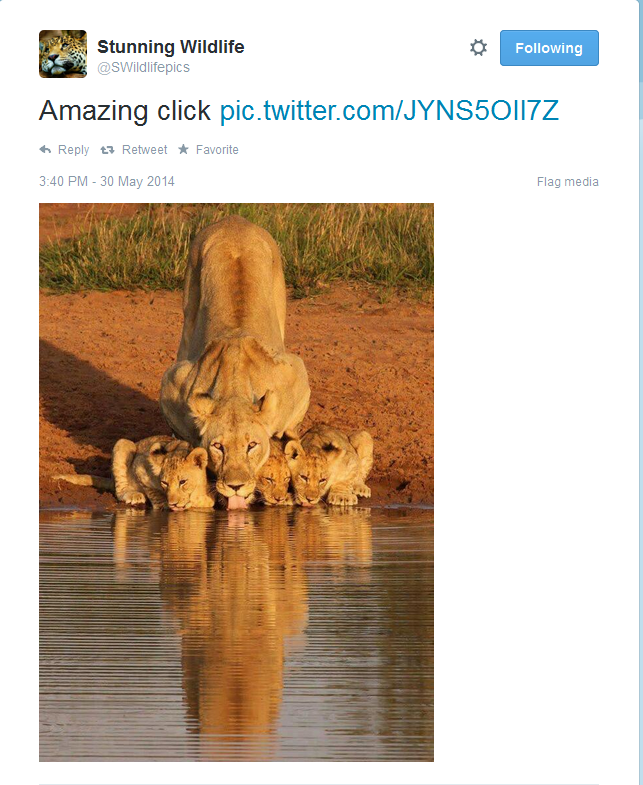
The fewer than 2,000 lions left in Kenya face many
threats, including retaliatory killings by herders who lose livestock to the big
cats. National Geographic 2014 Emerging Explorer and conservation biologist
Shivani Bhalla started a nonprofit, Ewaso Lions, to help herders learn to live
with lions—giving the big cats their best chance of survival.
The Explorers Project chronicles the work
of National Geographic's Emerging Explorers—tomorrow's visionaries who are
making discoveries, making a difference, and inspiring people to care about the
planet.
An interesing critique of a movie made in 1939.I could easily think of stranger movies but they would not fit the category of being such a huge success!
I have watched it many times, and on some of the points made I have to agree - especially the point re Scarlett and Ashley Wilkes. That never made sense to me either!
I have also read the book and some parts have been omitted. For example, Scarlett had other children.
I have never considered it "the strangest film". It is an historical costume drama like many, many others I have seen.
I think it has stood the test of time extremely well.It is still beautiful to watch any Technicolor movie, and it was very well-cast.
It should also be noted that slavery still exists in many parts of the world today.
The Civil War was not fought only on the issue of slavery. It was fought mainly on States' Rights and economic issues. If anyone should get the most credit for freeing slaves it is William Wilberforce.
Of course the movie has its trivial parts but it also has drama - elements that make a good film.
I think this movie should be judged chronologically: when Margaret Mitchell wrote it, and the period in which it takes place.
Societal values have changed enormously since then, thankfully.
There are many movies about the Civil War: "Friendly Persuasion" is one that comes to mind, as is "Glory", below, which I thought was extremely good.
Gone with the Wind is America’s
favourite film. It premiered exactly 75 years ago, but in a Harris poll
conducted in 2008, as well as an ABC News survey conducted in 2011, it was still
deemed better than any film released since 1939. The box-office figures agree.
If you adjust them to account for inflation, it stands as the most successful
film ever made.
As impressive as these statistics
are, though, they’re not particularly startling. Gone with the Wind has been
regarded as one of Hollywood’s crown jewels for so long that it’s easy to take
its status for granted.
We remember the sweeping scope and the bold Technicolor
vistas; we think of Vivien Leigh’s pert beauty and Clark Gable’s unparalleled
ability to make a moustache look sexy; we picture their characters’ torrid
clinches and verbal sparring; and we imagine that it’s the kind of film which
audiences were always bound to adore. But if you rewatch Gone with the Wind now,
what’s striking is how head-spinningly strange the entire thing is.
Far from being simple, wholesome
family entertainment, the film is an admiring portrait of a conniving, lying,
mercenary seductress. It’s a valentine to the slave-owning South, and a
poison-pen letter to the anti-slavery North. It’s a tonal rollercoaster that
plunges from frothy comedy to gruelling tragedy and back again. It’s a romance
that puts the hero and heroine at each other’s throats. And it’s an episodic
coming-of-age story that keeps going for nearly four hours before reaching its
abrupt, unresolved ending.
In short, Gone with the Wind is a preposterous,
almost unclassifiable mix of highly questionable elements. The wonder is not
just that it’s America’s most beloved film, but that it isn’t America’s most
hated.
The potential for disaster was
there from the beginning. The novel it was based on, by Margaret Mitchell, was a
runaway bestseller – but it was also 1,037 pages long.
David O Selznick, an
independent producer, paid $50,000 for the film rights, but the task of turning
the book into a screenplay was so perplexing that it was never actually
completed.
The script was written and rewritten countless times over the
following years, by F Scott Fitzgerald among many others, but Selznick himself
kept revising the dialogue every day while the film was in production.
Shooting
such a lengthy and complicated film was even more difficult.
Selznick
screen-tested 31 of America’s most popular actresses for the lead role, before
settling on Leigh, a relatively unknown Brit. He hired his friend, George Cukor,
to be the director, only to replace him with Victor Fleming after three weeks of
shooting. Fleming, in turn, had a nervous breakdown, and abandoned the project
for two weeks. As the budget spiralled, Gone with the Wind became known in the
gossip columns as ‘Selznick’s folly’.
‘Fast and
frivolous’ That all changed when it was
finally released. An immediate smash hit, it went on to win 10 Oscars and become
the most lucrative film of the year. Selznick’s perfectionism was vindicated –
as was his habit of popping Benzedrines so he could keep working for days on end
without sleep. But this triumph was by no means a sure thing. Audiences who fell
for the film could easily have been baffled instead.
Gone with the Wind doesn’t start
out as a blood, sweat and tear-stained historical epic, but as a cheeky,
sun-dappled romantic comedy. Scarlett O’Hara (Leigh) is introduced flouncing
around in a dress like a frilly parachute, trilling “fiddle-dee-dee!” and
fending off twin red-headed suitors.
The Civil War is on the horizon, but the
antebellum South is presented as “a whole world that wants only to be graceful
and beautiful”. And Scarlett doesn’t care about anything except that the man she
has her eye on, Ashley Wilkes (Leslie Howard), is engaged to his goody-goody
cousin Melanie (Olivia de Havilland). Not even the attentions of the rakish
Rhett Butler (Gable) can distract her.
The film’s next surprise is that
even when the Civil War commences, the tone remains as fast and frivolous as
ever. The death of Scarlett’s first husband is treated as a joke: there’s a
quick shot of a letter announcing that he has died of measles, and then Scarlett
is seen trying on hats to go with her widow’s weeds. In general, it’s
astonishing how speedy this four-hour film is.
A constant barrage of dramatic
upheavals ensures that you never catch your breath, and the editing is so nimble
that you hardly catch a glimpse of any of Scarlett’s three weddings. At a time
when The Hobbit can account for three films and The Hunger Games: Mockingjay can
cover two, it’s impossible to imagine a 21st-Century movie dealing with the same
material so snappily.
‘Ridiculous love
triangle’ After that sprightly first hour,
though, Scarlett is engulfed in the Civil War, and the mood turns very dark
indeed. Viewers who had been enjoying the farcical romantic shenanigans could
well have been appalled by the unsparing scenes of her traumatic nursing work
(which are echoed in Joe Wright’s Atonement and the forthcoming Testament of
Youth). And then there’s Scarlett herself: ruthless in her manipulation,
psychopathic in her determination, and strikingly modern in her social
impropriety. Few heroines in cinema history are quite as unorthodox.
Even more contentious is the
film’s treatment of its black characters. Mitchell’s novel was controversial
when it was first published, and despite Selznick’s efforts to omit its most
racially insensitive material, it’s still painful to hear Scarlett’s father
advising her, “You must be firm with inferiors – especially darkies.”
To the
film’s credit, Hattie McDaniel, who played Mammy, became the first African
American to win an Oscar. But Mammy’s two fellow black servants, Pork (Oscar
Polk) and Prissy (Butterfly McQueen) are demeaning caricatures. Malcolm X said
that McQueen’s performance made him feel “like crawling under the
rug”.
In some ways, however, a more
significant flaw opens up in the film’s last hour, when the story is no longer
about the Civil War’s effects on the South, or about Scarlett’s steel-willed
striving to regain her fortune. It’s about a ridiculous love triangle. She and
Rhett are married by this stage, but she still hankers after Ashley, the
vacillating stuffed-shirt who rebuffed her a decade earlier.
Perhaps no actor could ever have
competed with the devilishly charismatic Gable, but Ashley was played by a
toupee-wearing 46-year-old who didn’t want the part, hadn’t read Mitchell’s
novel, couldn’t stand Leigh and barely bothered to disguise his clipped English
accent.
The idea that anyone – let alone anyone as unconventional as Scarlett –
would choose this wishy-washy character over a swaggering alpha male like Rhett
is absurd: the most preposterous aspect of a daringly, bewilderingly
idiosyncratic film.
After 75 years, we’re still mesmerised by Scarlett. We’re
still tantalised by Scarlett and Rhett.
But Scarlett and Ashley? Frankly, we
don’t give a damn.
The field of audio is so mature
and saturated that coming up with a genuinely novel approach to speakers is a
rather steep challenge.
But a new product created by a
team in Oakland, California, takes audiophiles into new territory by delivering
a speaker that levitates — no, really, it levitates. Using the now well-known
idea of magnetic levitation, the speaker floats about an inch off its base,
allowing the user to spin it around in mid-air while listening to the audio.
After we had a chance to
test the Bluetooth speaker out in person, we can confirm that the product
does indeed work as described.
The Om/One device also
contains a microphone, allowing the levitating orb to take calls, too. On its
surface, which looks something like cross between the Death Star and a soccer
ball, is a hidden sensor that allows you to turn the device on and off as well
as pair it with your audio source, such as a smartphone.
OK, so it looks cool. But aside
from the novelty factor, why would you need a levitating
speaker?
"The fact that it levitates gives
us an angle on some audio techniques that make the speaker a lot better," David
DeVillez, the co-founder and CEO of Om Audio, told Mashable.
"The unit has a 3-watt RMS
[root mean square] amplifier inside of it, and it can produce a 110dB output,
where competitive products like the [Jawbone] Jambox or the
[Beats] Pill... they're using 9 to 10 watts to get 110dB," says
DeVillez, the former director of operations, R&D and engineering at Velodyne
Acoustics. Because the speaker is levitating
it's not syncing to any kind of surface, so it doesn't have any kind of low-end
loss … it's all coming through the
driver, which means we can get more audio output with less amplifier
power." While putting the device through
its paces, we snatched it off its magnetic perch to see how it might feel as a
portable speaker unit. It's a little on the heavy side, but not so much that
carrying it around in a bag would be particularly noticeable.
The only hiccup came when
replacing the speaker back on its levitation stand; that took a bit a practice.
Nevertheless, the Om/One will almost certainly snag the interest of music lovers
who want to add a bit of futuristic spice to their setups.
The device is scheduled to
go on sale in December for $179 and can be preordered on the company's website.
From You Tube: The Imitation Game comes out tonight, but before its release, Hank got
to talk with the film's director Morten Tyldum and screenwriter Graham
Moore about bringing one of the world's most brilliant mathematicians to
film. Hosted by: Hank Green Like SciShow? Want to help support us, and also get things to put on
your walls, cover your torso and hold your liquids? Check out our
awesome products over at DFTBA Records: http://dftba.com/scishow
Crumpled-up Alan Turing documents discovered in Bletchley Park Renovation
By Miles Gough
Top secret code-breaking documents drafted by Alan Turing during WWII
have been discovered in the ceiling of a building at Bletchley Park in
the UK.
Plugging structural holes with wastepaper seems like an
unconventional way to stop a draught. What’s even more unconventional is
using top secret documents devised by one of the greatest code-breaking
minds in human history.
But this is apparently what happened in Hut 6 at
Bletchley Park, where the famous mathematician Alan Turing and his
colleagues cracked the codes of the German Enigma machines, enabling
Allied Forces to anticipate Nazi movements.
The famous British code-breaking compound, which employed roughly 10,000 people during WWII, was shrouded in secrecy for nearly three decades afterward, with former staff prohibited from talking about their wartime duties.
More recently, however, the site has become a big tourist draw, and in 2013 multi-million dollar restoration effort began to salvage some of the decrepit buildings, including some of the huts occupied by Turing and his colleagues.
Renovations
on one of the buildings, Hut 6, turned up top secret documents stuffed
into holes in the ceiling. What’s more, is that these papers are
believed to have been created by Alan Turing, and should have been destroyed under British wartime laws.
The documents have been identified as ‘Banbury sheets', and may be the only surviving examples
of these code-breaking tools, which had holes punched through them to
allow manual comparison of enciphered texts. The cards, which were given
their name because they were printed in Banbury, England, exploit a
cryptology technique known as banburismus which was developed by Turing to more efficiently search for repeat patterns in the German code.
“Discovering
these pieces of code-breaking ephemera is incredibly exciting and
provides yet more insight into how the code breakers actually worked,”
Bletchley Park Trust chief executive Ian Standen told The Times.
“The
fact that these papers were used to block draughty holes in the
primitive hut walls reminds us of the rudimentary conditions under which
these extraordinary people were working.”
The huts at Bletchley Park were designed to be temporary structures
that could be easily demolished after the war, and the conditions
inside were known to be pretty grim. Fortunately for us, it means
documents that legally should have ended up in an incinerator for the
purposes of national security, have survived, albeit crumpled up and
hidden inside a ceiling for the better part of 70 years.
(And if you're
wondering why they look so good in the images, it's because they were
frozen at the time of discovery to prevent further damage, and later
cleaned and repaired).
In addition to the Banbury sheets, other
code-breaking documents were recovered that couldn't be identified,
Bletchley Park’s Director of Learning and Collections, Victoria Worpole,
said in a statement.
“Nobody
seems to be able to work out what they are – we’ve sent things off to
Government Communications Headquarters — and there are a number of items
that we’ve yet to understand properly. We’re unveiling a mystery.”
The Turing Digital Archives
already contain a number of personal letters, notes, photographs, and
unpublished papers written by the man who is considered to be one of the
fathers of computer science and artificial intelligence. Now, it seems,
there will be more documents to add to the already rich collection. With thanks to Science Alert. More pictures there.
The Grand Budapest Hotel amid BAFTA contenders
COMIC confection The
Grand Budapest Hotel is the surprise front runner for the British Academy Film
Awards, while English acting darlings Eddie Redmayne and Benedict Cumberbatch
are competing in the best-actor category.
WES Anderson's Hotel received 11
nominations on Friday, including best picture and best director.
Ralph Fiennes was
nominated for best actor as the unflappable concierge of a chaotic European
hostelry.
Acting nominees also
include Michael Keaton, as a washed-up actor aiming for a comeback in Birdman.
The Alejandro Inarritu-directed movie was nominated in 10 categories, as was
James Marsh's The Theory of Everything, which stars Redmayne as physicist
Stephen Hawking.
Redmayne said his acting
nomination was "beyond imagination".
He insisted he felt no
rivalry with Cumberbatch, who was nominated for playing World War II code
breaker Alan Turing in The Imitation Game. That film received nine
nominations.
"One can try and create a
rivalry but it will not happen!" Redmayne said from Los Angeles.
"We both absolutely
understand people wanting to pitch us against each other, but we are old, old
friends and I think he is the most wonderful actor. He is sensational in The
Imitation Game and I love watching him. "
Jake Gyllenhaal is also
nominated for his performance as a sleazy journalist in Nightcrawler.
But there was no
recognition for Timothy Spall, whose performance as artist JMW Turner in Mr
Turner took the best-actor prize at Cannes.
Best-actress contenders
are Felicity Jones for The Theory of Everything, Amy Adams for Big Eyes,
Julianne Moore for Still Alice, Rosamund Pike for Gone Girl and Reese
Witherspoon for Wild.
Other front runners
include Richard Linklater's decade-spanning Boyhood and Damien Chazelle's
drumming drama Whiplash. They have five nominations each.
The best-picture nominees
are Birdman, Boyhood, The Grand Budapest Hotel, The Imitation Game and The
Theory of Everything.
The separate category of
best British picture includes The Imitation Game and The Theory of Everything
alongside tense Northern Ireland drama '71, alien chiller Under the Skin and
animated ursine adventure Paddington.
Winners of the awards,
known as BAFTAs, will be decided by 6500 members of the British film academy and
announced at London's Royal Opera House on February 8.
The British prizes are seen as
an indicator of likely success at Hollywood's Academy Awards, whose nominees are
announced next week.