Accessing Universal Intelligence.
Human Ingenuity and Creativity. Our Cultural Heritage.
Favourite things. Music and Movies. Nature. Items that interest me on any topic.
NASA has published extraordinary new photographs of Jupiter, showing changes in one of the planet’s best known features. Each year, Hubble takes pictures of Jupiter and other outer planets of the solar system to show how they change over time.
The
latest images show that Jupiter’s famous Great Red Spot, a high
pressure storm similar to a hurricane on earth, has shrunk to about
16,000km across, 240km shorter than it was a year ago. The Hubble Space
Telescope shows that the spot is now more orange than red and it has a
unique filamentary feature in its core which has not been seen before.
“Every time we look at Jupiter, we get tantalising hints that
something really exciting is going on,” said Amy Simon, a planetary
scientist at NASA’s Goddard Space Flight Center in Greenbelt, Maryland.
“This time is no exception.” Hubble has also shown up a wispy
filament which rotates and twists throughout the 10-hour span of the
Great Red Spot image sequence, getting distorted by winds blowing at 150
metres per second (330mph).
The agency has published on its website an animated gif that showing
the movement of the planet’s clouds. The inset images show the Great Red
Spot in blue and red wavelengths, revealing the newly discovered
filamentary feature swirling inside it.
In Jupiter’s North
Equatorial Belt, the researchers found a wave that had been spotted on
the planet only once before, decades earlier, by Voyager 2. The current
wave was found travelling at about 16 degrees north latitude, in a
region dotted with cyclones and anticyclones, NASA reports.
Until now, we thought the wave seen by Voyager 2 might have been a
fluke,” said co-author Glenn Orton of NASA’s Jet Propulsion Laboratory
in Pasadena, California. “As it turns out, it’s just rare!”
Filmmaker Greg Krehel captures 15 varieties of stunning Echinopsis
cactus flowers blooming in this incredible time-lapse. The process
happens overnight, and the flowers last for only a day, with a peak
period occurring for a mere hour or two.
The
Short Film Showcase spotlights exceptional short videos created by
filmmakers from around the web and selected by National Geographic
editors. We look for work that affirms National Geographic's mission of
inspiring people to care about the planet. The filmmakers created the
content presented, and the opinions expressed are their own, not those
of the National Geographic Society.
Every (British) schoolboy, every patriot knows
what Henry V used to defeat the French: his “band of brothers”, of
course, but above all archers, men who at Agincourt with bows of yew
would lay waste to an army several times the size of their own. Yet long before Britannia ruled the waves, Henry was also a king
who placed extraordinary faith in the value of naval war power. When he
set sail across the Channel, it was with a massive fleet of — if
contemporary reports are to be believed — up to 1,500 ships. Now,
on the eve of the 600th anniversary of the Battle of Agincourt, the
wreck of one of Henry’s great ships may have been discovered buried in
the mud of an English river. The wreck that has lain hidden in the
River Hamble in Hampshire for so long is believed to be the Holigost —
or Holy Ghost — the second of four “great” ships built for Henry V’s
royal fleet, according to Historic England, the government heritage
agency. The wreck was first spotted from an aerial photograph by Ian Friel, a
historian, next to Henry’s flagship, the Grace Dieu, which was
identified in the 1930s. Historic England is taking steps to
protect and investigate the shipwreck, which Dr Friel identified as
likely to be the Holigost when he was revisiting documentary evidence
for his new book, Henry V’s Navy. Future scientific research on
the vessel, which could include sonar and aerial imaging using drones,
could reveal much about 15th-century shipbuilding and improve
understanding of life on board, naval warfare of the time, dock building
and docking practices. The Holigost, which had a crew of 200 and
took large numbers of soldiers to war, was a major part of Henry’s war
machine as he sought to conquer France. It took part in operations
between 1416 and 1420, including two of the sea battles in the Hundred
Years’ War that broke French naval power. It was the flagship of
the Duke of Bedford at the sea battle of Harfleur in 1416 — not to be
confused with the siege of Harfleur of 1415 — and in the thick of the
fighting off the Chef de Caux in 1417. Dr Friel said: “Unlike the Grace
Dieu, which was the biggest ship of late medieval England, the Holigost
actually saw action. The Grace Dieu was a bit of a white elephant — it
was too late for the war. “At the Battle of Harfleur it saw very
heavy action. There is documentary evidence that enemy boarders must
have boarded the ship. There were very concerted attempts to destroy the
rigging that held the mainmast up.” The ship, whose name comes
from Henry’s personal devotion to the Holy Trinity, was originally
rebuilt from a Spanish vessel called the Santa Clara that was captured
in late 1413 or early 1414 and then acquired by the English Crown.
Underwater repair work on the ship carried out by a “dyver” called Davy
Owen in 1423 may be the first recorded example of a diver used in ship
repair in England. Duncan Wilson, chief executive of Historic
England, said: “The Battle of Agincourt is one of those historic events
that has acquired huge national significance. “To investigate a
ship from this period close to the 600th anniversary is immensely
exciting. It holds the possibility of fascinating revelations in the
months and years to come. Historic England is committed to realising the
full potential of the find.” Dr Friel said: “I am utterly
delighted that Historic England is assessing the site for protection and
undertaking further study. In my opinion, further research leading to
the rediscovery of the Holigost would be even more important than the
identification of the Grace Dieu in the 1930s. “The Holigost
fought in two of the most significant naval battles of the Hundred
Years’ War, battles that opened the way for the English conquest of
northern France.” Events are being held around the country for the
600th anniversary of the Battle of Agincourt, including a service at
Westminster Abbey on October 29. By Valentine Low With many thanks to The Australian
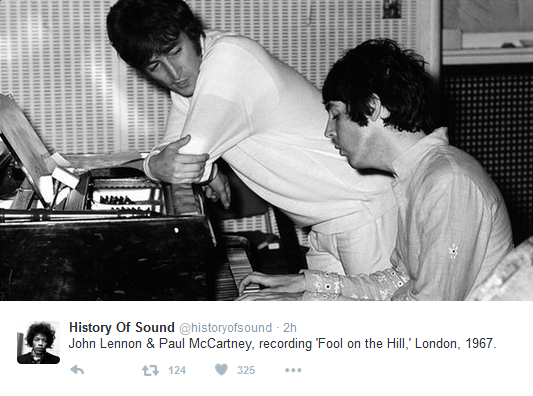
Today in 1940, John Lennon
was born in Liverpool, England. Lennon was a co-founder, singer, songwriter and
guitarist with The Beatles, who sold more than 20 million singles
worldwide between 1962 and 1970, and scored more U.K. and U.S. No. 1 albums than
any other group. Post-Beatles, Lennon enjoyed a successful solo career that
produced the critically acclaimed albums John Lennon/Plastic Ono Band and
Imagine, and iconic songs such as "Give Peace a Chance," "Working Class
Hero" and "Imagine." On Dec. 8, 1980, Lennon was killed outside his New York
home by a gunman. In 2002, a BBC poll voted Lennon eighth in a list of 100
Greatest Britons. Lennon was posthumously inducted into the Songwriters Hall of
Fame in 1987 and into the Rock and Roll Hall of Fame twice — as a member of the
Beatles in 1988, and as a solo artist in 1994.
Also, Today In: 1961 - Ray Charles started a two
week run at No. 1 on the U.S. singles chart with "Hit The Road Jack." 1964 - The Beach Boys recorded
"Dance Dance Dance," with Glen Campbell playing the lead-guitar intro. It would
go on to become the Beach Boys' 12th Top 40 hit. 1964 - Because of an
anti-apartheid embargo by the British Musicians' union, the Rolling Stones
cancelled a South African tour. 1965 - The Beatles started a
four-week run at No.1 on the U.S. singles chart with the Paul McCartney ballad
'Yesterday' giving the group their tenth US No.1. 1973 - Elvis Presley and
Priscilla divorced after six years of marriage. Priscilla was awarded property,
$725,000 cash and $4,200 a month support. 1975 - Sean Taro Ono Lennon was
born, the only child of John Lennon by Yoko Ono; John and Sean share the same
birthday (John was 35 when Sean was born). Sean went on to become a singer,
songwriter, musician and actor. 1976 - Walter Murphy and the Big
Apple Band went to No. 1 on the U.S. singles chart with "A Fifth Of Beethoven,"
a disco rendition of the composer's Symphony No. 5, Op. 67, First
Movement. 1978 - Belgian singer-songwriter
Jacques Brel died of cancer at age 49. Artists who have recorded Brel's songs
include Ray Charles, Frank Sinatra, Dusty Springfield, David Bowie and Nina
Simone. 1993 - Nirvana entered the U.S.
album chart at No. 1 with In Utero, their third and final studio
album. 2007 - The Imagine Peace Tower
was officially unveiled near Reykjavik, Iceland. The memorial to John Lennon
from his widow, Yoko Ono, consists of a tall "tower of light" projected from a
white stone monument that has the words "Imagine Peace" carved into it in 24
languages. With many thanks to The
Current
Yoko Ono Celebrates John Lennon’s 75th Birthday In Iceland
Yoko Ono will commemorate her husband John Lennon’s 75th
birthday today, October 9, with the annual lighting of Imagine Peace
Tower on the island of Videy, Reyjkavik, Iceland.
Imagine Peace Tower is a conceptual tower of light emanating from a
stone base into which the words ‘Imagine Peace’ are carved in 24
languages. It was unveiled by Ono in 2007 and she has visited Reyjkavik
every year since then to initiate and participate in the lighting
ceremony. This year is the 9th year.
Imagine Peace Tower is lit every year on October 9 and darkened on Dec 8, the day Lennon was killed.
Over 1 million hand written wishes have been received from people all
around the world and these are buried beneath Imagine Peace Tower.
Yoko Ono said today: “Every year so many people celebrate John’s life
in different and very special ways. I’m always so proud that John’s
legacy just grows and grows and resonates with new generations all
around the world. It always chokes me up to see his message still out
there. Music helps create a global village and John’s music is very much
woven into our lives and will continue to be so forever.
He wanted a
better planet and together we tried to make it so. The message he was
promoting was clear and direct and is as needed today as it was then.
All we are saying is give peace a chance! I love you John”.