Showing posts with label Success. Show all posts

October 02, 2016

The Nobel Prizes In Numbers


Five prizes were created by Alfred Nobel in his 1895 will, for medicine, physics, chemistry, literature and peace, which were awarded from 1901. A sixth prize in economics, “in memory of Alfred Nobel,” was created by Sweden’s central bank in 1968.

Six laureates have declined the prize. The only two to do so of their own will were France’s Jean-Paul Sartre, who turned down the 1964 literature prize, and Vietnam’s then-prime minister Le Duc Tho, who refused to share the 1973 Nobel Peace Prize with US Secretary of State Henry Kissinger. 

Adolf Hitler forbade three German laureates -- Richard Kuhn (chemistry 1938), Adolf Butenandt (chemistry 1939) and Gerhard Domagk (medicine 1939) -- from accepting the prize, while Soviet authorities forced Boris Pasternak to decline the 1958 literature prize.

Eight laureates were born on February 28 and May 21, the two most popular birthdates for laureates. Other dates have produced no laureates, including January 2 and October 13.

Twelve is the number of times the medicine prize jury considered the nomination of Sigmund Freud, the father of psychoanalysis, rejecting it each time.

His work had no scientific value, an expert concluded in 1929. 

The nomination of Mahatma Gandhi, who also famously never won a Nobel, was considered four times, excluding the year of his assassination in 1948.

The youngest laureate to be honoured was 17 years old — Malala Yousafzai of Pakistan (peace 2014). The oldest laureate was Russian-born American Leonid Hurwicz (economics 2007), who was 90.

Eighteen laureates have been affiliated with the two universities claiming the most Nobels: Stanford and the University of California, Berkeley.

Myanmar’s Aung San Suu Kyi had to wait 20 years before she could travel to Oslo to collect the peace prize she was awarded in 1991.

 Also deprived of their liberty: German pacifist Carl von Ossietzky (peace 1935), who died in 1938 without being allowed to leave his country; and Chinese dissident Liu Xiaobo (peace 2010), is still behind bars.

Twenty-seven English-language writers have won the literature prize, ahead of French (14), German (13) and Spanish (11) laureates.

Forty eight women have won a Nobel prize, including Marie Curie who won it twice (physics 1903 and chemistry 1911). 

The economics prize, with only one female laureate, in 2009, and the physics prize, with only two laureates in 109 years, remain the most inaccessible prizes for women.

 A total of 822 Nobel laureates are men.

The various juries have decided to not award the prize 49 times. The peace prize has had no recipient 19 times, most recently in 1972.

Fifty years must pass before the juries’ top secret deliberations are opened to the public.

The average age of the economics prize laureates is 67, the oldest average age, while the youngest average age can be found among physics laureates, at 55.

There were 376 nominations for the 2016 Nobel peace prize, a record with almost 100 more than in 2014 when the previous record was set. In 1942, 1943 and 1944, no nominations were accepted.

870 people have won a Nobel prize, including four scientists who won it twice. Twenty-six groups or organisations have been honoured with the Nobel peace prize, such as Tunisia’s National Dialogue Quartet in 2015.

1,350 people are typically invited to the Nobel gala banquet celebrating the laureates, held each year at Stockholm’s city hall on December 10, in honour of the death of Alfred Nobel. 

At the first dinner in 1901, 113 people were invited.

Each laureate is awarded 8 million Swedish kronor ($1.2m) which is shared if several laureates are honoured in the same field. 

Literature laureates are the ones most likely to take home the whole sum: on 104 occasions there has been just one literature winner.
With many thanks to The Australian 


Source. 


Congratulations to David Thouless, Duncan Haldane and Michael Kosterlitz for winning the 2016 Nobel Prize in Physics!

Bob Dylan Wins The Nobel Prize In Literature


Malala Yousafzai Quotes: Heartwarming,Thoughtful and Inspirational! 

He Named Me Malala - Review 


Modern Technology and Albert Einstein: Are We There Yet?

Top Ten Things Women Invented

Alan Turing Manuscript Sells For $1 million 

Temple Grandin On The Autistic Brain

Benedict Cumberbatch And Eddie Redmayne: The Changing Face Of Hollywood 


Temple Grandin: Her Extraordinary Life And Work  
     
Hedy Lamarr's 101st Birthday Celebrated by Google    

 Mathematical Minds Stir A Beauty Within

Modern Technology and Albert Einstein: Are We There Yet?

Arthur Benjamin: The Magic of Fibonacci Numbers

Claude Shannon Jr: The Greatest Genius No One Has Heard Of

John von Neumann: This Hungarian-American Mathematician May Have Been Smarter Than Einstein 

Great Minds: Filippo Brunelleschi

Great Minds: Leonardo da Vinci

The Genius of Nicola Tesla

Hedy Lamarr - Beauty And Brains in Abundance

The New Turing Test:Brainy Machines Need An Updated IQ Test, Experts Say 

Alan Turing Manuscript Sells For $1 million 

 'Albert Einstein Font' Lets You Write Like Physics Genius

Do You See Albert Einstein Or Marilyn Monroe In This Photo? 

Albert Einstein: Inspiring Quotes on Nature and Life

Albert Einstein: 25 Quotes

Warp Speed Space Travel A Possibility Thanks To Einstein's Theory Of Relativity

Einstein's Famous Theory Has Aged Well 

Jason Padgett: Brain Injury Turns Man Into Math Genius

 Mad Geniuses: 10 Odd Tales About Famous Scientists

Benjamin Franklin:11 Surprising Facts

 Last Piece of Einstein’s Theory Of Relativity In Line For Final ‘Proof’

10 Mathematical Equations That Changed The World

11 Female Inventors Who Helped Power The Information Age 

Biopics Now Focus On Key Moments Rather Than A Whole Life 

Some Biopic Actors And Their Real-Life Counterparts


German WWII Coding Machine Found On eBay For $20

Creators Of Modern Cryptography Win Turing Award

High school student Ryan Chester wins $350,000 For Film Explaining Einstein's Theory Of Relativity

Quantum Enigma Machines Are Becoming A Reality

Albert Einstein: Photographic Evidence Reveals His First Prediction Of Gravitational Waves

Never Ever Give Up! - Famous Failures 

Student Builds Super-smart Robot That Paints Award-winning Einstein Portrait

What Was the Enlightenment?
 
Albert Einstein's Legacy


January 14, 2015

Tommy Caldwell And Kevin Jorgeson On The Edge Of History By Climbing El Capitan - Now Achieved!


El Capitan is located in Yosemite National Park. It is an incredible monolith and the entire park is a fantastic experience. I saw mountain climbers attempt El Capitan when I was there. They looked like ants! That gives you a bit of an idea of its size and the effort involved in such a challenge.

FOR Sir Edmund Hillary, comradeship was “the greatest of all feats” and the force that drove him upwards. George Mallory provided another glimpse into the adventurer’s mindset: “Because it’s there,” he quipped when asked why he was tackling Everest.
Now, the world is captivated by two more men hellbent on achieving something never done before — and this time the healing of a broken heart is a big part of the motivation. Tommy Caldwell, 36, has lived on El Capitan, a 900m-tall granite monolith in California, for 19 days. He and Kevin Jorgeson, 30, are inching their way up the Dawn Wall, considered the toughest free-climb ever attempted. They will reach the summit this week, possibly even today, hoisting themselves into the annals of climbing history.
 
According to Caldwell’s wife, Becca, it was the breakup of his first marriage, to the elite rock climber Beth Rodden, that first drew him to the challenge.

“The Dawn Wall started out as an escape from a deep pain Tommy felt from the sadness of splitting up,” Mrs Caldwell said on her blog. When he first studied the route, “he deemed the wall impossible to free-climb,” she said. But then he met Becca. “He came back to it and with the excitement of a budding relationship between us decided that the Dawn Wall just might be possible. Our relationship began with this route, and the Dawn Wall has weaved its way through our lives together over the past six years.”

El Capitan, a 900m-tall granite monolith in California.


Last week Caldwell, 36, completed the final sections of the route that he considered “extremely hard”. He had tears in his eyes as he made it to a spot known as Wino Tower — so-called because another climber, Warren Harding, weathered a storm there in 1970 and when park officials tried to rescue him he rebuffed them, offering them some wine instead. Caldwell could have pressed on alone, but he appears to share Sir Edmund’s respect for comradeship. Instead, he waited to support his partner, Jorgeson, who had struggled with a difficult section for a week.

Caldwell’s faith in his colleague was well placed: late on Monday, Jorgeson made it to Wino Tower, and the two are now at the same stage. The remaining 1,000 feet, while still challenging, is technically easier. “This journey isn’t over yet, but we can start to see what it might look like standing on top of this route. And it’s beautiful,” Mrs Caldwell said.

by Rhys Blakely

                                                                        
Above: Film clip of Yosemite National Park.
                                                              
With thanks to The Australian

Yosemite climbers reach peak of El Capitan granite rock face


THE two climbers scaling a sheer slab of granite in California’s Yosemite National Park without climbing aids have reached the top of the 914-metre (3000 ft) peak after more than two weeks of effort. 
 Shortly before 10.30am AEDT, 30-year-old Kevin Jorgeson and 36-year-old Tommy Caldwell reached the summit of El Capitan on Wednesday, said spokeswoman Jess Clayton.
 
“I feel like the most proud person in the world right now,” said Caldwell’s 39-year-old sister, Sandy Van Nieuwenhuyzen shortly before the men reached the peak. She said she can’t wait to hug her younger brother. “I’m just going to hug. Just hug. No words necessary,” she said.

The two men began their climb on December 27 and have been free-climbing, a technique that shuns climbing aids other than harnesses and ropes to prevent falls.

The world has been watching the pair’s gruelling journey up the peak’s Dawn Wall route. But Clayton says they men won’t give media interviews at the top, instead waiting until Thursday to discuss their ascent.

Throughout the climb, both men have had their fingers sliced by the needle sharp handholds on the granite wall and have needed to take rest days to wait for their skin to heal. They used tape and even superglue to help with the process. Caldwell has set an alarm to wake him every four hours to apply a special lotion to his throbbing hands.
The men also took physical punishment when their grip would slip, pitching them into long, swinging falls that left them bouncing off the rock face. The tumbles, which they called “taking a whipper,” ended in startling jolts from their safety ropes.

Eric Jorgeson, Kevin Jorgeson’s father, told KGO-TV his son has always been a climber and watching him fulfil a long-time dream makes him proud.

“He climbed everything he could think of. It made us nervous early on as parents, but we got used to it,” the father said.

The two started climbing El Capitan (there are more than 100 routes to the top) when Kevin Jorgeson turned 15, and it has been a birthday tradition ever since.

From The Australian -  January 15th

Yosemite National Park In HD


December 10, 2014

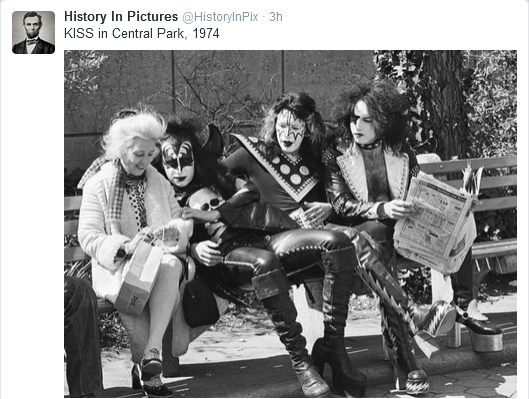
Gene Simmons’ Hit Book A Kiss And Sell On His Business Success


You can't say Gene Simmons was ever a 'pretty face' and now he proves he is much more. 
The reviews of his book on Amazon are very good.

The concert with Kiss and the MSO was quite a treat! Enjoy this small clip!

Clip above from You Tube:
Kiss Symphony: Alive IV is a 2003 live album from Kiss performing with the Melbourne Symphony Orchestra (MSO). The arrangements were made by David Campbell, who also conducted the MSO. It is the group's fourth album in the Alive series and first release under Kiss Records and Sanctuary Records. The album featured three of the original members of Kiss (Peter Criss, Paul Stanley, and Gene Simmons). Ace Frehley once again left the band and the concert featured for the first time a replacement musician, Tommy Thayer, dressed as Ace Frehley's "Spaceman".
The members of the Melbourne Symphony Orchestra who accompanied Kiss during this performance wore makeup that mimicked the band members. At the same time they also wore tuxedos.

[....]


NOBODY touches Kiss, snarls Gene Simmons, the bass player and co-founder of the cheesy, ageing rock band. 
“We outsell the Rolling Stones and Elvis put together. But I don’t mean ticket sales.”

Kiss are the original rock’n’roll sellouts. They may have shifted more than 100 million albums thanks to hits such as Crazy Nights and I Was Made For Lovin’ You, but the secret to the band’s riches is not so much the rousing vocals or innuendo-laden lyrics but the money machine they created on the side.

Simmons, 65, more or less invented music merchandising, slipping a flyer advertising Kiss T-shirts inside the sleeve of the band’s debut LP. In the 41 years since they took the stage, he and his bandmates have milked sales of “oooh, close to $US5 billion ($5.97bn)” from the Kiss logo and the trademarked image of their black-and-white-faced stage personas.

There are Kiss cruise holidays, credit cards, a wedding chapel and even an American football team — more than 3000 product lines in all, including tie-ups with the likes of Coca-Cola and Hello Kitty. “There are Kiss condoms and Kiss burial caskets — we get you coming, then we get you going,” says Simmons with a filthy laugh.

As the brains behind this commercial behemoth, Simmons has amassed an estimated personal fortune of $US300m — more than twice that of his co-founder Paul Stanley. The frontman has reinvested his wealth in everything from a life assurance company to racecourses. 

He discovered Van Halen and managed Liza Minnelli.

He also starred in a long-running reality show — for which he was reportedly paid $US125,000 an episode — based around life with his wife, the soft-porn actress Shannon Tweed, and their two children.

Having long been recognised by the likes of Forbes magazine for his obvious business nous, Simmons has now decided to dispense his commercial wisdom to the masses with a motivational book containing life lessons for wannabe entrepreneurs.

His brief but blunt guide to success, titled Me, Inc, has been a surprise success, reaching No 3 in the Wall Street Journal’s business book lists in its first week.

It is not the drug-fuelled tale of life on the road that one might expect from a rock legend famous for gyrating on stage in a spike-encrusted suit of armour while suggestively licking his “axe”.

Instead it is a brutal right-wing tirade against the perils of mixing with “losers, communists and socialists”, and filled with heavy-handed paternal lectures.

Rule No 1 in the Gene Simmons manifesto is that men should not get married in their twenties. Statistically there is a high probability you will get divorced, and thus lose half your wealth, he argues.

Do not buy a house until you can pay for it in cash. (He revealed that Cher insisted he pay rent when they lived together in the 1970s, and he had a similar arrangement when dating Diana Ross.) Stop smoking, stop drinking, don’t take holidays, don’t buy your friends dinner — the list goes on.

If it all sounds a little austere, then “too f … ing bad”, snorts Simmons. “Mother Nature doesn’t give a shit whether you like gravity or not, it simply exists. If you are falling out of a building, then gravity can feel a little unfair too.”

He continues: “It is self-empowering when you understand that the word ‘more’ is a good thing. And all the losers who say, ‘When is it enough?’ — don’t hang around with them.

“People think of money in the wrong way. I think of it as philanthropy, as job creation. I have never been given a job by a poor person.

It is only people who make a lot of money who create jobs. That’s not a very romantic ideal, but it is profoundly true.”

Simmons has always been a parody of himself — it’s part of the Kiss charm. While they masquerade as a heavy metal band, they never had the screaming guitar solos of AC/DC, baroque drum scores of Led Zeppelin or the crunching chords of Metallica. It was all about catchy tunes with four chords that people could sing along to, with some make-up and platform boots thrown in.

Of all the acts on stage today, it’s country popstrel Taylor Swift who Simmons seems to admire most — for the business acumen she displayed in removing her songs from the Spotify music platform.

“Rock’n’roll is dead — I can prove it to you,” he says. “Right now the music industry is in chaos. From 1958 to 1988, name me 100 or 1000 iconic superstars that will go down in history. I have Elvis Presley, the Beatles, the Rolling Stones, Jimi Hendrix, Led Zeppelin, the whole of Motown, even Madonna, Prince, Michael Jackson. It goes on and on. Abba — it continues to resonate generation after generation. Queen, AC/DC, Metallica.

“From 1988 to today … how many years is that? Give me five acts, five rock bands that are going to go down in the annals of rock history as iconic.”

He dismisses Nirvana as a two-album wonder, then grumbles about Foo Fighters. “We think of the Ramones as a classic, iconic band,” he continues. “They have one gold record to their name. They never played arenas, couldn’t sell them out. It was a failed band. It doesn’t mean they weren’t great. It means the masses didn’t care.

“The pop acts today are doing terrific. Katy Perry, Rihanna, Shakira — any girl that ends her name with an ‘A’. And that’s great, and I wish them great success. Many of them are very clever.”

Music labels are all “in chaos”, he says. “Any time there is no structure and no rule of law, there is chaos. What Taylor Swift did is pretty smart. She knows who her fan base is. She took all her stuff off the downloading platforms because she says she isn’t getting paid. Why should she work for free?

“Would Kiss do the same? It’s a possibility. But, respectfully, we make so much goddamn money everywhere else it may or may not be an issue.”

Making music was always about making money for Simmons. He moved to New York aged eight, having been born in Israel to Jewish- Hungarian parents who fled from Nazi concentration camps. He saw the Beatles on television and wanted to be like them.

Simmons’ real name is Chaim Witz. His first self-taught lesson in branding came when he realised that Jewish-sounding names were not very saleable to Middle America. He spent hours parroting television newscasters to perfect the mid-Atlantic celebrity drawl. To earn a living he took courses in typing and stenography, and then had a string of unlikely jobs, including assistant to the editor of Vogue magazine.

He and Stanley had several bands before settling on the formula for Kiss in 1972. Simmons put his sharp business sense to work at one of their earliest gigs. They had been booked to play at the Crystal Room in New York’s Hotel Diplomat, as a support act for the Brats, a popular group at the time with legions of screaming fans.

Simmons, then 24, volunteered to take control of the contracts and publicity for all three acts performing that night.

The Brats had no idea that the flyer he sent to the record labels and music magazines said just one band was playing that night, “Heavy Metal Masters ‘Kiss’?”.

They brought the house down, aided by the drummer’s two sisters who had been planted at the front of the stage in tight black T-shirts featuring the now famous logo. Afterwards swarms of talent scouts clustered around Simmons, who had arranged for an on-off girlfriend to sit on his knee to give him extra rock-god kudos. The agents had left before the real headliners even took the stage.

It would be another three years before Kiss decided to perform in make-up, taking inspiration from outfits Simmons and Stanley saw in the Hallowe’en parade on New York’s Sixth Avenue after leaving a recording session at the nearby Electric Lady studios.

“I saw four men dressed as us. They weren’t called Kiss, they didn’t have guitars, but they had the make-up and the outfits. I went, ‘Wow’,” Simmons said.
Shortly afterwards the characters of Starchild, the Demon, Catman and Spaceman were born — and with them the multimillion-dollar brand.

“At Hallowe’en, or at costume parties, you cannot dress up as Coldplay. Or U2, unless you just put on a pair of sunglasses. They picked the fruit before it was ripe. They are just bands — and terrific bands with classic songs and all that stuff. But they are avoiding the issue: we don’t just have ears, we have eyes.”

Simmons bristles at being called a sellout. “I sell out every night,” he retorts, sarcastically.
“Rock’n’roll is a very strange animal because it’s not supposed to have rules. But the well-educated among us, the critics — who, it bears noting, live mostly in their mothers’ basements and have never achieved anything — they sit in the peanut gallery and use words like commercialisation and sellout.

“I have always been boldly assertive that money is good and fun, and it makes me happy. The more money I have, the happier I get. What we’ve heard, that money is the root of all evil, is bullshit. It is untrue. Lack of money is the root of all evil.

“If I am sitting on my net worth now — and I am worth whatever it is they say I am worth — why would I want to go and hold up a 7-Eleven store? If I didn’t have any money, I might consider it.”

By Iain Dey


With thanks to The Australian

Picture credit:NYPost

Related:

Kiss Legend Paul Stanley Recalls Wild Life Of Sex, Drugs, Rock And Roll


June 02, 2014

Charles Aznavour: Still Singing At 90!


I am no stranger to French singers, and yet I thought the Rolling Stones were doing well with Mick Jagger turning 70 recently and still going strong.

If this is a new benchmark then we may have another 20 years of the Rolling Stones to look forward to. Charles Aznavour is booked out till November this year - so far!

Not to mention so many other music legends! The You Tube clip is 10 years old but you get the picture.

London (AFP) - Legendary French-Armenian singer Charles Aznavour, who celebrated his 90th birthday on stage in Berlin last month, defied the years to charm 5,500 spectators at London's prestigious Royal Albert Hall on Sunday.

Taking the limelight to a standing ovation, the activist-singer promised the audience: "I'll sing half in English, half in French...tonight is about Entente cordiale".

Surrounded by seven musicians and two singers, the giant of French song began his set with "Les emigrants", in tribute to the world's migrants.

Looking relaxed in a dark suit, blue shirt with Mao collar and red braces, Aznavour made light his 90 years -- an age when "one sees badly and hears badly" -- but warned the audience he needed a teleprompter in case of memory lapse.

Despite frequently resting on a high chair, the chanteur's well-honed showmanship commanded the stage, with the audience reacting to every clenched fist and pained lament.
Aznavour recently said he still "writes every day, often a song a day," and revealed the secrets of his success.

"I try to be free with respect to music, and to find a good melody that is easy to remember," he explained.

The audience -- made up of many French and Armenians -- heard many of Aznavour's best-known songs, including "Mes Emmerdes", "She" and "Take Me Along", but it was his gypsy-inspired "Les deux guitares" and "La Boheme" that ignited the grand old venue.

Bouquets of flowers rained down on the stage as the crowd stood for a minute-long ovation, ​​but their pleas for an encore went unheeded.

So it was without "La Mama", "Pour faire une Jam" and "Les Comediens" that the concert ended after nearly two hours.

Aznavour will play Barcelona on June 26, Rome on July 1, Los Angeles on September 13, Geneva on October 10 and Antwerp on November 22.


With thanks to Yahoo News.