June 07, 2015

Top Things Women Invented


Josephine Cochrane: The Dishwasher

Out of frustration, the dishwasher was created.  Tired of having the hired help chip her good china, Cochrane developed the creation using wire and high pressure hot water.  She got it patented in 1886, and started selling it to hotels and restaurants around the world.  It eventually took off and is the basis of what we have in most of our homes today.


Mary Phelps Jacob: The Modern Brassiere

Though many had tried before her, Phelps Jaco had the revolutionary idea to create a bra that separated the breasts into two individuals instead of what we know today as the “bandeau style”.  Unlike corsets, which had whalebone and metal rods that forced women to alter their natural shape, her product was soft and gentle, going naturally with the female body and making it popular.  She sold the design to the Warner Brothers Corset Company, and it became what we know today.


Grace Hopper: BM-Harvard Mark 1

Among other things, Hopper was famous for creating the first generation of the IBM computer.  She is seen as the mother of this first history-making model and was responsible creating the word “bug” to describe a technical problem.  Also on her list of accomplishments was creating a compiler which changed writing into computer code.  By the time of her death, she had over 30 universities awarding her honourary degrees.


Mary Anderson: The Windshield Wiper

No one can argue that this wasn’t one of the best inventions ever, originating as a squeegee that was attached to a spindle.  Car owners said originally that these were dangerous inventions because they would distract the driver, but it wasn’t long before everyone had them in their cars, turning them manually until the automatic creation came about.


Margaret Knight: The “Queen” of Paper Bags

She had the amazing idea to create a machine that would give the original paper bag (shaped similar to an envelope) a flat bottom.  This idea was stolen from her by a man who said that no woman could come up with as good an idea as that, but her drawings awarded her the credit, and throughout her life, she was awarded with over 25 patents for inventions that we still use today in one form or another.


Hedy Lamarr: Secret Communications System

This useful creation was originally created to help bring down the Nazis in WWII, but didn’t go into use until much later.  This system was a line of code that prevented any sensitive information from being understood or intercepted by the enemy, therefore creating a much safer communications line for the soldiers that were hard at work.

With many thanks to One More Post


Related:
 Hedy Lamarr - Beauty And Brains in Abundance
11 Female Inventors Who Helped Power The Information Age
Hedy Lamarr's 101st Birthday Celebrated by Google
Temple Grandin On The Autistic Brain
The Nobel Prizes In Numbers


Get To Sleep In 60 Seconds


A deep-breathing trick can make insomniacs drop off to sleep in less than one minute, according to a health expert.

The method involves holding the breath in stages then exhaling with a loud whooshing noise. This “4-7-8” method has been pioneered by US sleep expert Dr Andrew Weil, who claims the technique works by calming the mind and relaxing the body.

Breath control

More than 1.5 million Australians suffer from poor sleep, with stress, mobile devices and taking work home often blamed for the lack of quality rest. Consistently poor sleep puts you at risk of medical conditions such as obesity, heart disease and diabetes, and it can also shorten your life expectancy.

But Weil, the founder of the Arizona Center for Integrative Medicine at the University of Arizona, says a simple alteration to your normal breathing could be the answer. 

“This comes from yoga breathing techniques where you keep the tip of the tongue behind the upper front teeth,” he says. “You breathe in through your nose quietly and blow air out forcefully through your mouth, making a whoosh sound. 

It takes about 30 seconds, so there’s no excuse for not doing it, and it produces a pleasant altered state of consciousness. You may not get that the first time you do it but it’s one of the benefits of practising.”

The trick is to breathe in quietly through the nose for four seconds, then hold for seven seconds and exhale completely for a count of eight. The steps are then repeated between two and four times.

Weil says it’s effective because it allows the lungs to become fully charged with air, allowing more oxygen into the body, which promotes a state of calm

“You have to do this two times a day religiously. It will become a wonderful way to help you fall asleep,” he says. “You can do it more often throughout the day if you wish.
“It’s utterly simple, takes almost no time, requires no equipment and can be done anywhere. After about four to six weeks, you’ll see wonderful changes in your body.”

The benefits

Weil says this technique can be used to deal with cravings and control anger. He also claims it can combat the “fight or flight” response in the body, lowering stress levels.

The method is based on an ancient Indian practice called pranayama, which roughly translates to “regulation of breath”, and is used widely in yoga and Pilates.

Research has shown that breathing exercises such as pranayama can have instant effects by changing blood pressure. But more importantly, they can be used as a method to train the body’s reaction to stressful situations and dampen the production of harmful stress hormones. Rapid breathing makes the body think it’s stressed, but deep breaths stimulate the opposing parasympathetic reaction, which calms you down.

In 1975, Harvard University researcher Herbert Benson discovered that short periods of deep-breathing meditation triggered a “relaxation response”.

 Following decades of research, he claimed in 2010 that it could lead to genetic changes that counter the effects of stress. “It does away with the whole mind-body separation,” Benson says in his book, The Relaxation Response. “You can use the mind to change the body, and the genes we’re changing [are] the very genes acting in an opposite fashion when people are under stress.”

Whether or not such techniques help you fall asleep in 60 seconds, there’s no doubt being mindful of your breath helps you relax.

Sleep needs throughout life

Newborns
  • 0-3 months
  • Recommended: 14-17 hours
  • Not recommended: Less than 11; more than 19

Infants
  • 4-11 months
  • Recommended: 12-15 hours
  • Not recommended: Less than 10; more than 18

Toddlers
  • 1-2 years
  • Recommended: 11-14 hours
  • Not recommended:Less than 9; more than 16

Preschoolers
  • 3-5 years
  • Recommended: 10-13 hours
  • Not recommended: Less than 8; more than 14

School-age kids
  • 6-13 years
  • Recommended: 9-11 hours
  • Not recommended: Less than 7; more than 12

Teenagers
  • 14-17 years
  • Recommended: 8-10 hours
  • Not recommended: Less than 7; more than 11

Young adults
  • 18-25 years
  • Recommended: 7-9 hours
  • Not recommended: Less than 6; more than 11

Adults
  • 26-64 years
  • Recommended: 7-9 hours
  • Not recommended: Less than 6; more than 10

Older adults
  • 65+ years
  • Recommended: 7-8 hours
  • Not recommended: Less than 5; more than 9

What happens to a sleep-deprived body?

A long-term lack of sleep has been linked to a greater risk of obesity, heart disease, stroke and diabetes. So what’s behind this association? The University of Chicago in the US has conducted various studies into human sleep deprivation and observed that even after a few days of reduced sleep, the following physical changes can occur:
  • Higher blood pressure (a factor in stroke and heart disease)
  • Higher levels of the stress hormone cortisol (which impacts heart health and body weight)
  • Lower levels of antibodies (which fight viruses and infection)
  • Increased insulin resistance (a precursor to type 2 diabetes)
  • Higher levels of the hormone ghrelin (which triggers hunger)
With many thanks to Body and Soul
Picture credit: Razimo's Deviant Art

Many thanks to Jo for mentioning this to me.


Leonard Nimoy Immortalized In The Asteroid Belt


I am pleased to learn that actor Leonard Nimoy has been given a singular honor: The asteroid 4864 Nimoy has been named after him.

The asteroid is very roughly 10 km across and is in the main belt between Mars and Jupiter. It orbits the Sun once every 3.9 years.

Oh, how I wish it had a seven year period!

Its orbit is very slightly elliptical (Spock would no doubt inform you that it has an eccentricity of 0.1778108147152254, with a 1-sigma uncertainty of 6.3351e-08), and orbits the Sun in almost the same plane as Earth. It was originally discovered in 1988. In the orbital diagram above, I chose to display the position of 4864 Nimoy on the date of his death, Feb. 27, 2015.

In the announcement, a brief statement was made:
Discovered 1988 Sept. 2 by H. Debehogne at the European Southern Observatory.
Leonard Nimoy (1931-2015) was an American actor, film director and poet. Best known for his portrayal of the half-Vulcan/half-human science officer Spock in the original "Star Trek" TV series and subsequent movies, Nimoy wrote two autobiographies: I Am Not Spock (1975) and I Am Spock (1995).
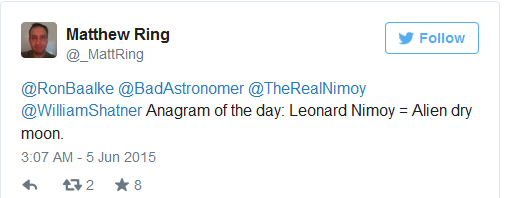
Very nice. Amusingly, on Twitter Matthew Ring noted this:


Heh. Ironically, it may not be as dry as all that. At that location in the asteroid belt there’s some chance of ice inside Nimoy.

And another layer of irony: Some people may think that Vulcans were incapable of emotion, but in fact they felt emotions even more strongly than humans; they just kept them more tightly under control. It wasn’t ice under Spock’s skin, it was barely constrained lava.

And I have to wonder. Sometime between now and the 23rd century, will we have visited this mountain-sized rock? And in that (hopefully promising) future, will Star Trek still be the inspiration it is for so many today?

I hope so. May its, and Nimoy’s, legacy live long and prosper.

By Phil Plait

With many thanks to Slate.


2,000-yr-old Pearl Found In Australia


Australian scientists said Wednesday they have uncovered a ‘very rare’ 2,000-year-old natural sea pearl - the first found on the vast island continent - while excavating a remote coastal Aboriginal site.


Archaeologists were working the site on the north Kimberley coast of Western Australia when they came across the unique gem below the surface, said Kat Szabo, an associate professor at the University of Wollongong. ‘Natural pearls are very rare in nature and we certainly - despite many, many (oyster) shell middens being found in Australia - we've never found a natural pearl before,’ Szabo, who specialises in studying shells at archaeological sites, told AFP.


A midden is a prehistoric refuse pit. ‘The location makes it particularly significant because the Kimberley coast of Australia is synonymous with pearling, and has been for the better part of the last century.’ The pink-and-gold-coloured pearl is almost spherical, with a five-millimetre diameter. Due to its near-perfect round shape, the researchers used a micro CT scan to test its age and prove that it was naturally occurring rather than a farmed modern cultured pearl.


The oysters that produce pearls have been used in rainmaking ceremonies in indigenous cultures, and their shells have been found in the central desert more than 1,500 kilometres (930 miles) away.–AFP 


Archaeologists have known about the rainmaking rituals but were not aware of how far back in history they had been practised. ‘Studying the pearl has led us to the study of the layer in which it's found,’ Szabo said.


‘In indigenous terms, that's telling a really interesting story about a cultural tradition to do with pearl shells which we knew historically but we've never been able to prove that it went back into the past.’ 


The pearl is set to go on display at the Western Australian Maritime Museum in Perth later this month, with details of the find published in the Australian Archaeology journal.

With thanks to The Nation


June 03, 2015

Wildlife In Ultra HD


From You Tube

Superb photography!

To view this video in 4K select "Original" in the resolution menu.

This is some footage that we captured while in Myanmar. It didn't make it to the first cut but we figured it was worth posting for everyone to enjoy.

This video was sponsored by Harmonic. 


Special thanks to this company who sent us to the other side of the world and introduced us to a new world. You can check out more about Harmonic on their website:
http://www.harmonicinc.com/

Music By Dexter Britian
Song: Did You Feel It


Music Licensed with Music Bed

All 4K content are available upon commercial request. Shot on Red Epic.

Make sure to follow us on Twitter and Instagram for BTS and sneak-peaks at upcoming projects.

TWITTER: http://www.twitter.com/jakeschwarz
INSTAGRAM:http://www.instagram.c/jacobschwarz                                        


NASA To Test Flying Saucer For Mars Landing


The US space agency plans to try out the largest parachute ever deployed during a flying saucer launch that will test new technologies for landing on Mars. 
The test flight of the flying saucer, known as the Low-Density Supersonic Decelerator, will be broadcast live on NASA’s website beginning at 1.30pm local time on Wednesday (0330 AEST Thursday). Since the atmosphere on Mars is so thin, any parachute that helps a heavy, fast-moving spacecraft touch down needs to be extra strong.

The US space agency figured out how to do this decades ago, beginning with the Viking mission which put two landers on Mars in 1976.

But with the goal of sending humans to Mars in the 2030s, the agency is now testing a more advanced, new generation of parachute technology, known as the Supersonic Ringsail Parachute, that could allow even heavier spacecraft — the kind that may have humans and months of food and supplies on board — to land softly. 


The Low-Density Supersonic Decelerator at the US Navy Pacific Missile Range Facility in Hawaii.
 
“We want to see if the chute can successfully deploy and decelerate the test vehicle while it is in supersonic flight,” NASA’s Jet Propulsion Laboratory said in a statement.

The test vehicle weighs 3088 kilograms, or about twice the weight of the kind of robotic rover spacecraft NASA is currently capable of landing safely on Mars.

The parachute, described by NASA JPL as “the largest parachute ever deployed,” is 30 metres in diameter.


The goal is for the chute to “slow the entry vehicle from Mach 2 to subsonic speeds,” NASA said.

The test will involve sending the saucer, an inner-tube shaped decelerator and parachute to an altitude of 37 kilometres over the Pacific Ocean with the help of a giant balloon.

The balloon will release the spacecraft and rockets will lift the vehicle even higher, to 55 kilometres, reaching supersonic speeds.

“Travelling at three times the speed of sound, the saucer’s decelerator will inflate, slowing the vehicle, and then a parachute will deploy at 2.35 times the speed of sound to carry it to the ocean’s surface,” NASA said.

With many thanks to The Australian


John Nash’s Astonishing Geometry


As has been widely reported, John Forbes Nash Jr died tragically in a car accident on May 23 of this year. Many tributes have been paid to this great mathematician, who was made famous by Sylvia Nasar’s biography A Beautiful Mind and the subsequent movie based on that book.

                                                                   
As has been widely reported, John Forbes Nash Jr died tragically in a car accident on May 23 of this year. Many tributes have been paid to this great mathematician, who was made famous by Sylvia Nasar’s biography A Beautiful Mind and the subsequent movie based on that book.

Much has been said about Nash’s work on game theory. But less has been said about Nash’s other mathematical achievements. Many mathematicians who understand Nash’s work would agree, I think, that although his work in game theory had the most impact on other fields, Nash made other breakthroughs which were even more impressive.

Apart from game theory, Nash worked in fields as diverse as algebraic geometry, topology, partial differential equations and cryptography.

But perhaps Nash’s most spectacular results were in geometry. To honour Nash’s life, I would like to try to give a flavour of some of this work.

John Nash and pure mathematics
A great deal of Nash’s work was in the field of geometry. But this kind of geometry - differential geometry - is very different from the geometry learned at high school. It is not about trigonometry or Pythagoras, as found in secondary maths textbooks. Rather, it is about topics like surfaces, curvature and smoothness.
Like all pure mathematicians, Nash proved theorems: logical statements that are rigorous, precise and absolutely true, with no tolerance for vagueness. The world of pure mathematics is austere and often abstruse, but its claims to truth are eternal and absolute.
Well, that’s the theory at least. Breakthroughs in pure mathematics are often at the very limits of human understanding. It takes time, even for those in the field, to fully comprehend new developments.

Nash’s work was an extreme case. His papers could be chaotically presented, hard to follow and his approaches to problems were often unlike anything that had come before him, bamboozling students and experts alike. But he was almost otherworldly in his creativity.
While mathematical arguments are tightly constrained by the rigorous requirements of logic, Nash’s constructions and methods were wild. And nowhere was this more so than in his work on geometry.

Nash’s geometry
Take a flat sheet of paper. You can bend it, but without ripping it or creasing it, what shapes can you make? You can’t make a sphere, or even a section of a sphere, because a sphere is curved, while the paper is flat.
But you can make a cylinder. And even a cone, as you’ll know if you’ve ever seen a dunce’s hat. 

As it turns out, even though a cylinder or a cone looks curved, it is intrinsically flat. In an undergraduate course on differential geometry (such as the one I teach at Monash), one studies this intrinsic curvature, and it turns out that there are lots of flat surfaces.
These ideas were around for hundreds of years before Nash, but Nash took them much further.

The embedding problem
Nash took up the idea of 'embedding' a surface: placing it into space without tearing, creasing or crossing itself. An embedding which does not distort the surface’s intrinsic geometry is 'isometric'. In other words, the surfaces above are 'isometric embeddings' of the plane into 3-dimensional space.

The isometric embedding question can be asked not just for the plane, but for any possible surface: spheres, donuts (which mathematicians call tori to try to sound respectable) and many others.

As it turns out, there are surfaces that are so strongly curved or tangled up that they cannot be embedded into 3-dimensional space at all. In fact, they can’t even be embedded into 4-dimensional space.

But Nash showed that any surface can be embedded into 17-dimensional space. Extra dimensions, far from making the problem even more difficult, actually make it easier - giving you more room to embed your surface! Later on, Nash’s work was improved by others, and we now know that any surface can be embedded into 5-dimensional space.

However, surfaces are only 2-dimensional. And Nash was interested in surfaces of any possible dimension. These higher dimensional analogues of surfaces are known as 'manifolds'.
Nash proved that you can always embed a manifold into space of some dimension, without distorting its geometry. With this momentous result, he solved the isometric embedding problem.

Nash’s proof of the isometric embedding problem came as a complete surprise to much of the mathematical community. His methods were revolutionary. The great mathematician Mikhail Gromov said that Nash’s work on the embedding problem struck him to be “as convincing as lifting oneself by the hair”. But after great effort, Gromov finally understood Nash’s proof: at the end of Nash’s lengthy argument, Gromov said, Nash “miraculously, did lift you in the air by the hair”!

Isometric embedding in action
Gromov went on to develop his own ideas, inspired by Nash’s work. He wrote a book - similarly renowned among mathematicians for its incomprehensibility, just like Nash’s work - in which he developed a method called 'convex integration'.

Gromov’s method had several advantages. One is that it is easier to draw pictures of an embedding made with his convex integration method. Prior to Gromov, we knew isometric embeddings existed, and had wonderful properties, but had a very tough time trying to visualise them, not least because they were often in higher dimensions.

In 2012, a team of French mathematicians produced computer graphics of isometric embeddings using Gromov’s convex integration methods. They are extremely intricate, almost fractal-like, yet smooth. Some are shown below.

The world in a grain of sand
Nash’s work on the isometric embedding problem has many facets and has led to huge amounts of subsequent research.
One particularly amazing aspect is how isometric embeddings are constructed. Nash’s work, combined with subsequent work by Nicolaas Kuiper, showed that if you wanted to isometrically embed a surface in 3-dimensional space, it’s enough to be able to shrink it.
If you have a 'shrunken' embedding of your surface - that is, with all lengths decreased - then Nash and Kuiper show how you can obtain an isometric embedding of your surface just by adjusting your shrunken version a bit.

This sounds ridiculous. For instance, take a sphere - say the surface of a tennis ball - and imagine shrinking it down to have a nanometre radius. Nash and Kuiper show that by 'ruffling' the surface sufficiently (but always smoothly; no creasing or folding or ripping or tearing allowed!) you can have an isometric copy of your original tennis ball, all contained within this nanometre radius. This type of 'ruffling' of the surface was reproduced in the French team’s computer graphics.

The French team considered taking a flat square piece of paper. Glue the top side to the bottom side, to get a cylinder. Now glue the left side to the right side. If you think about it, you might be able to see that you get a donut. But you’ll find the paper is now creased or distorted.

Can you embed it into 3-dimensional space without distortion? Nash and Kuiper say “yes”. Gromov says “use convex integration”. And the French mathematicians say “this is what it looks like”! (second picture above).

More pictures are available at the Project’s website.

But the mathematical theorem doesn’t just apply to tennis balls or donuts: the theorem holds for any manifold of any dimension. Any world can be contained in a grain of sand.
How did he do it?

Nash had a rare combination of genius and hard work. In her biography of Nash, Sylvia Nasar details his formidable intensity and effort spent working on the problem.

As is well known from the movie, Nash came to believe in outlandish conspiracy theories involving aliens and supernatural beings, as a result of his schizophrenia. When later asked why he, an extremely intelligent scientist, could believe in such things, he said those ideas “came to me the same way that my mathematical ideas did. So I took them seriously”.

And frankly, if my head told me ideas as accurate and as insightful as those needed to prove the isometric embedding theorem, I’d likely trust it on aliens and the supernatural too.

Daniel Mathews is Lecturer in Mathematics at Monash University

With many thanks to Science Alert

Also related:

Hedy Lamarr's 101st Birthday Celebrated by Google

Five Brilliant Mathematicians And Their Impact On The Modern World

Arthur Benjamin: The Magic of Fibonacci Numbers

Claude Shannon Jr: The Greatest Genius No One Has Heard Of

John von Neumann: This Hungarian-American Mathematician May Have Been Smarter Than Einstein 

Great Minds: Filippo Brunelleschi

Great Minds: Leonardo da Vinci

The Genius of Nicola Tesla

Hedy Lamarr - Beauty And Brains in Abundance

Inside The Mind Of Teenage Maths Genius Alex Gunning

The New Turing Test:Brainy Machines Need An Updated IQ Test, Experts Say 

World Wide Web Turns 25

Benedict Cumberbatch And Eddie Redmayne: The Changing Face Of Hollywood

Biopics Now Focus On Key Moments Rather Than A Whole Life

The Best Movies Of 2014

Some Biopic Actors And Their Real-Life Counterparts

 Mathematical Minds Stir A Beauty Within

Warp Speed Space Travel A Possibility Thanks To Einstein's Theory Of Relativity 

10 Mathematical Equations That Changed The World

Jason Padgett: Brain Injury Turns Man Into Math Genius


 Mad Geniuses: 10 Odd Tales About Famous Scientists


Creators Of Modern Cryptography Win Turing Award
 
A Mathematician Has Built A Machine That Can Beat The Odds In Roulette


What Was the Enlightenment?

Quantum Enigma Machines Are Becoming A Reality

Albert Einstein's Legacy

The Nobel Prizes In Numbers


Gottfried Wilhelm Leibniz: The Philosopher Who Helped Create the Information Age