Showing posts with label Mind. Show all posts

February 01, 2014

Amanda Ripley: The Smartest Kids in the World And How They Got That Way


New York Times bestseller, The Smartest Kids was selected by The Economist, The Washington Post, The New York Times and Amazon.com as one of the most notable books of 2013.

In a handful of nations, virtually all children are learning to make complex arguments and solve problems they’ve never seen before. They are learning to think, in other words. What is it like to be a child in these new education superpowers?

In a global quest to find answers for our own children, author and Time journalist Amanda Ripley follows three Americans embedded in these countries for one year. Kim, 15, raises $10,000 so she can move from Oklahoma to Finland; Eric, 18, exchanges an upscale Minnesota suburb for a booming South Korean city; and Tom, 17, leaves a historic Pennsylvania village for a gritty city in Poland.

Their stories, along with groundbreaking research into what works worldwide, reveal a pattern of startling transformation: none of these places had many “smart” kids a few decades ago. 

They had changed. Teaching had become more serious; parents had focused on what mattered; and children had bought into the promise of education. A reporting tour de force, The Smartest Kids is a book about building resilience in a new world—as told by the young Americans with the most at stake.

With many thanks to Amanda Ripley


 More here:


Book Review here

By Jonah Edelman
The Smartest Kids in the World: And How They Got That Way is a gripping new book by Amanda Ripley that answers the question, "what exactly is happening in classrooms in the countries that out-perform the U.S. academically?" Ripley investigates this question by spending time where the action is: in classrooms abroad, specifically in Poland, South Korea, and Finland. Her "informants" are American high school students who chose to study in those countries, and foreign students who come to the U.S. to study. 

I literally couldn't put The Smartest Kids in the World down. Ripley's characters are fascinating, her writing style is accessible, and her observations are fresh. There's no hint of tired education talking points or polarizing rhetoric. Ripley lets facts and firsthand observations guide her conclusions, not the other way around. 

The first "aha" moment in The Smartest Kids is this: The performance of students in other countries has changed dramatically over time. In some countries, such as Poland and Finland, it has improved markedly; in others, such as Norway, which has a homogeneous population, low poverty rate, and generous social safety net, it has gotten significantly worse . The U.S. is actually the exception, not the norm, in that we have plodded along at the same level for decades as other countries pass us by. 

The fact that student achievement levels across the world are so dynamic is an enormously hopeful fact. If other countries have steadily improved their performance, we can, too.

But how? What gives in the countries that have already surpassed the U.S. or are heading that direction? If you ask Ripley's "moles," the students from the U.S. who studied abroad in other countries, they'll tell you it's due to a few key things (and it's worth noting that their findings are backed up by a broad survey of students who have studied in and outside the U.S.). 

The first is rigor. The level of expectations and work required in the non-U.S. classrooms is higher. The experience of Tom, a Pennsylvanian studying in Poland whom Ripley profiled, is a good example. In Tom's U.S. math classes, everyone used calculators. In Tom's classroom in Poland, everyone did math in their head, to the point that it seems like they were fluent in a language he was not. And after every test the teachers publicly announced how each student had performed, from a 1 (lowest) to a 5 (highest). Tom waited all year for someone to get a 5. No one ever did. Compare this to American classrooms, where A's are common and GPAs are often over a 4.0. 

The second thing is the teachers. The teachers in the highest-performing countries come from the top of their college classes, even top-performers in college work extremely hard to get accepted into teacher-training schools, and teachers are highly respected and well-paid. You may already have heard that about Finland, for example, but Ripley uncovers something that isn't talked about much: it wasn't always that way. 

In the 1970s the teacher training landscape in Finland looked a lot like it does now in the U.S.: a lot of teacher preparation programs, many of which were mediocre, a low bar for who was accepted into the programs, and limited oversight. As part of a broader education reform movement, the government closed low-performing teacher-training colleges and ensured the remaining schools raised the bar for entry. It was extremely controversial at the time. And it worked.

The last thing is parent involvement. In other countries, Ripley reports, parents aren't asked to come into the classroom and volunteer, or to fundraise for their school. Schools don't lament that lack of parent involvement because there is general agreement that parents should be involved where they are needed: at home. This is something that our family engagement program Stand University for Parents teaches our parents: the most impactful thing you can do for your child is to work with him or her on reading, writing, and math at home. (You can read more on my thoughts on the highest-impact family engagement here). 

If you're interested in how to improve public schools, read Ripley's book today

And after you read it, tweet about it to me @JonahEdelman. I'd love to hear your thoughts.
With thanks to The Huffington Post


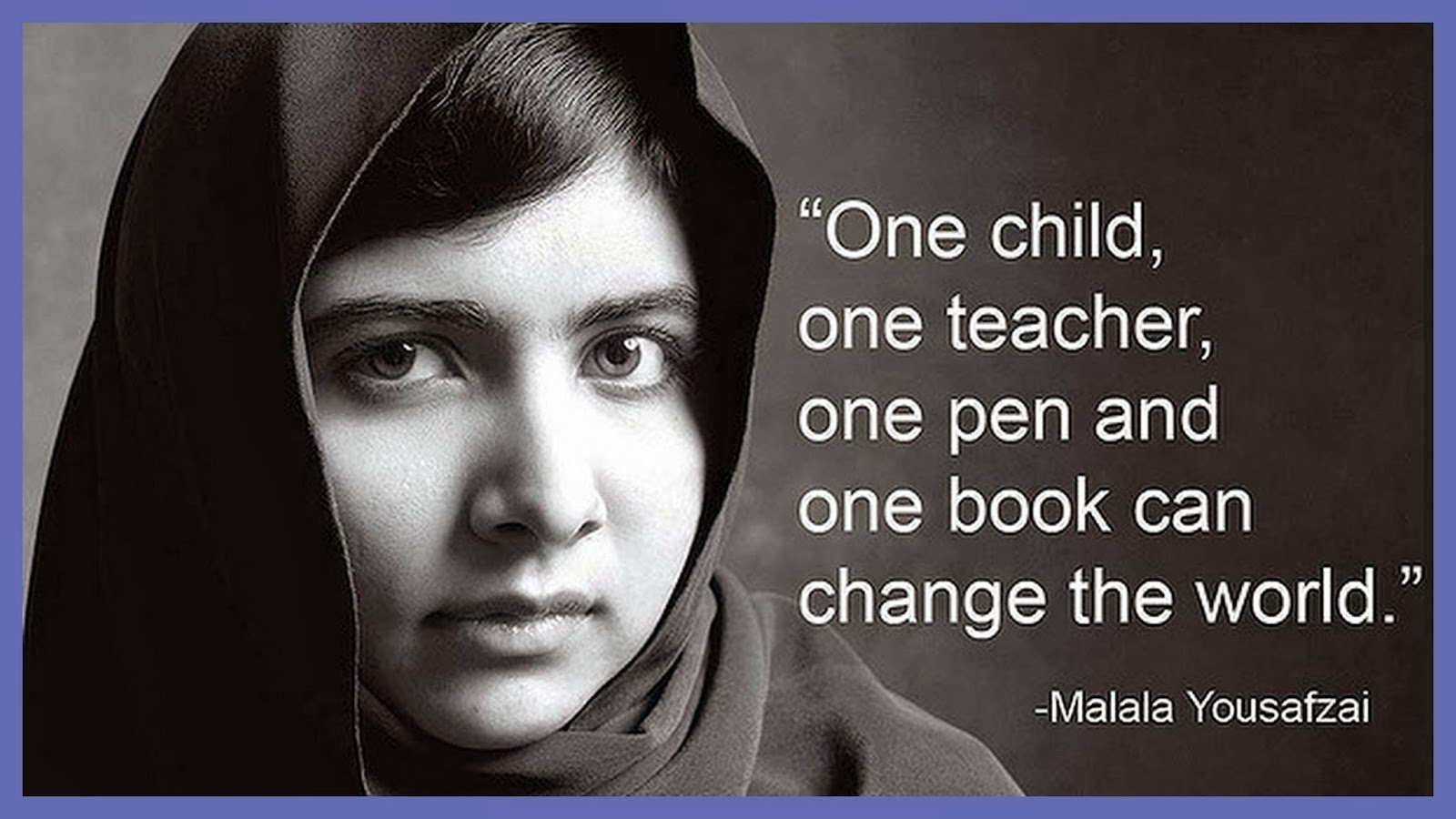
And words from a much younger voice say the same: Malala Yousafzai - see side bar.


September 13, 2013

Claude Shannon Jr: The Greatest Genius No One Has Heard Of


This is incredible really. Claude Shannon Jr is responsible for everything digital and no one has heard of him – until now! Combine his work with that of Hedy Lamarr (see post on side bar) and you have  incredible possibilities, for example cellphones!
It would be hard to imagine life without these things!

In the 1930′s, “computer” was a job description: someone, usually a woman of mathematical bent, with an adding machine and a big sheet of columnar paper who performed a rigorous routine of hand calculations, using paper and pencil, slide rules and tables of logarithms. Stone knives and bearskins weren’t involved, but to modern eyes they might as well have been.

Large research organizations and the Department of War had a few special purpose mechanical computers intended to integrate differential equations. Vannevar Bush (who deserves his own article someday) brought a young grad student to MIT to work on the differential analyzer, a relatively advanced version of these.

This video, above, shows a version of the differential analyzer being applied to a problem for which it was utterly unsuited in Earth vs. the Flying Saucers .

This young man, a recent graduate of the University of Michigan, was named Claude Shannon, Jr. Shannon, while working on the differential analyzer, had the insight that these same computations could be done using combinations of a few simple circuits that performed basic logical operations on true and false values. He described how this could be done, and invented the whole concept of digital circuits, which derive from from Shannon’s thesis on what he called switching theory.


His Master’s thesis.
At about the same time, Alan Turing wrote his series of famous papers on computability; those papers included an idea of how a computer with memory might work, but without Shannon’s switching theory, no one knew how to actually build one. (Google did a great Google Doodle for Turning’s 100th birthday.)

Vannevar Bush then sent Shannon to the Cold Spring Harbor laboratory. Shannon worked with biologists and geneticists, and — remember this was before DNA had been discovered — described how genetics could be understood as an algebra using a small collection of symbols. This was enough to get Shannon a Ph.D. but attracted little attention at the time. 

However, his Ph.D. is now recognized as pre-figuring what we now call bioinformatics.

During the war, Shannon, still working for the War Department, was put to work on cryptography, where he merely invented a general mathematical basis of nearly all cryptography, and in the meantime proved that there is one and exactly one method of making an unbreakable cipher. This is called a one-time pad.

But this wasn’t enough. He went to work for Bell Labs, and began thinking about radio or telephone signaling. (His original switching theory was already the basic for new telephone switches — direct telephone dialing depended on Shannon’s Master’s.) What was common to all these different ways of signaling we already used: telegraph, telephone, radio, and that new-fangled thing television? Shannon had a surprising insight: what made a signal a signal was whether or not you could predict it.

To understand this, think about a game of 20 questions. You and an opponent are playing. Your opponent thinks of something, you ask the standard first question of “animal, vegetable, or mineral?”, and then you have to guess the opponent’s some “thing” with no more than 19 questions. The only other rules are that your opponent can’t lie, and the questions have to be yes or no questions. If you guess it correctly, you win; if you run out of questions, your opponent wins.

Surprisingly often, a skillful player can guess in considerably fewer than 20 questions, as each question reduces the collection of possible answers.

Now, here’s Shannon’s big insight — and if it doesn’t seem big now, just wait a minute: if you have fewer than about 1.6 million choices (really, 1,572,864) then you can always find the answer in 20 questions, or looking at it the other way, a game of 20 questions can distinguish about 1.6 million possible guesses. So getting a 20 questions game right on the first question is literally a million to one shot.

So, if you have two choices, say Republican or Democrat, then you can predict the answer after one question.

With three or four choices, say Ford, Mercedes Benz, Volkwagen, or Chrysler, you can be sure you have the answer after 2 questions. Eight choices means three questions.

So, if you have two choices, and you guess right the first time, you’re not very surprised. With eight, if you guess right the first time, you’re more surprised. With 1,572,864, if you get it first guess you’re very surprised.

Shannon’s first insight was that what we call “information” was basically a measure of the size of the surprise, and he could measure that with the number of yes or no questions you need to ask to distinguish among all the possibilities.

We call that count of yes/no questions, this measure of “the size of the surprise”, a bit.
Information theory shows up in communications, too. In communications, the idea is to think of the amount of information as how well you can predict what the next message will be. You can see this every day on the news: watching MSNBC is usually very predictable, but other channels are less so. By the way, when something is completely unpredictable, we call it “random”. A random number is like throwing a fair die: getting a 5 shouldn’t give you any information about what the next throw will be.

Mathematically, this is the logarithm to the base 2 of the number of different possibilities, but if that doesn’t mean anything to you (what do they teach kids in school these days?) don’t worry about it. What matters is that this one insight is the basis of what’s now called information theory, and as time has gone on, information theory shows up over and over again in describing the real world.

This one man, Claude Shannon, is directly responsible for computers, the internet, CDs, digital TV, really for digital anything


Although I haven’t gone into it here, information theory shows up in communications — Shannon’s information theory is directly responsible for the way cell phones and communications with space probes work — in biology, in finance, even in physics, where information theory is at the heart of much of what Stephen Hawking has been doing for the last 20 years. Nearly every bit of technology we use today that’s more complicated than a Phillips head screw is based on what Shannon did. And yet, most people have never heard of him.
Well, now you have.
                                                         
With many thanks to PJMedia


Update: According to "Mysteries at the Museum" Claude Shannon and a fellow mathematics colleague invented a tiny computer that accurately foretold the next number to come up on the roulette wheel. They only used this device once and no one knows how much they won.
I am guessing it was Alan Turing.

Related:
Temple Grandin On The Autistic Brain
 Mathematical Minds Stir A Beauty Within
John von Neumann: This Hungarian-American Mathematician May Have Been Smarter Than Einstein
Great Minds: Filippo Brunelleschi
Great Minds: Leonardo da Vinci
The Genius of Nicola Tesla 
The New Turing Test:Brainy Machines Need An Updated IQ Test, Experts Say
Alan Turing Manuscript Sells For $1 million 
Hedy Lamarr's 101st Birthday Celebrated by Google
Mad Geniuses: 10 Odd Tales About Famous Scientists
Benjamin Franklin:11 Surprising Facts
Creators Of Modern Cryptography Win Turing Award
German WWII Coding Machine Found On eBay For $20
A Mathematician Has Built A Machine That Can Beat The Odds In Roulette
What Was the Enlightenment?
Quantum Enigma Machines Are Becoming A Reality
Albert Einstein's Legacy
The Nobel Prizes In Numbers
Gottfried Wilhelm Leibniz: The Philosopher Who Helped Create the Information Age


See also Hedy Lamarr - Inventor of Wi-Fi. Click on image in side-bar.


April 23, 2013

Robina Courtin: Meditation is not mystical


"DON'T say 'stilling your mind' - you won't still your mind sweetheart - your mind is going to be as berserk as normal." 
 
Robina Courtin likes to tell it like it is when giving instruction on the mind, meditation or just about anything.

Best known for her work inside some of the roughest and bleakest quarters of prisons in Australia and the US, including death row, the Melbourne-born, Catholic-raised Tibetan Buddhist nun cuts through the cliches of religion at lightning speed. Public lectures are fast, furious and rarely leave the student guessing. " 

Don't expect your thoughts to go away. Don't think of meditation as some magic pill which is how some people think about it. It's not like that . . . and don't mystify these words . . . and please, I beg you, don't feel it's holy. It's not," she told a recent gathering in Sydney.

In truth, Courtin maintains a deep respect for the holy, an attraction held long before she was ordained 35 years ago. But it is her no-nonsense, at times confronting, translation of Buddhist psychology that has created a following as she blasts apart all the usual stereotypes pervading religion and the "spiritual".

With a turbo-charged energy that defies her 68 years, Courtin's teaching schedule has her on a permanent global road trip that now sees her back in Australia. Stress, anxiety, addiction and heartbreak are all in the mix as she makes her way across the country, guiding people on how to tackle the everyday miseries of a modern world.

"Being a Buddhist is being your own psychologist, being your own therapist. What that means is really learning to listen to what the hell is going on inside," Courtin says. 

"The main cause of the misery and the neuroses and the unhappiness in our life is not the outside, but it's the inside."

There are many factors that come together to produce our unpleasant and pleasant experiences - in other words, suffering and happiness - and we assume that the main factor involved is "the thing out there", whether it be an object, person or event.

And this is where we run into trouble, Courtin explains. "Everything in us believes that 'you're' the problem, 'it' is the problem, my 'mother's' the problem, my 'genes' are the problem. For sure they play a role, but the main factor is what goes on in our head," she says.
 
"And the main thing going on in our head, which underlies everything else, is attachment - this bottomless pit of dissatisfaction that gives rise to the assumption that I must get what I want every microsecond; it's just there all the time, running the show - it's a junkie mind, desperate for nice things."

It is when the junkie does not get what it wants - what it is attached to - that anger, fear, stress or anxiety can arise, even at the most basic level. Think of the stress or even anger at the driver who cuts in front of us.

 Courtin points to concentration techniques such as meditation as a way to slow the automatic thought processes down to alter them.

"It's then that we can hear the underlying stories, viewpoints, opinions, and gradually change them. Our minds are the one thing we can change," she says. 

"These techniques aren't religious -- believe me, it's got nothing to do with believing in anything."

Perhaps there is no more glaring example of changing habitual thinking as that seen with some of the male prisoners Courtin has worked with over the years through the Liberation Prison Project, an initiative she founded in 1996 to support inmates in Australia and the US. It formed the basis of the 2000 documentary on Courtin's life, Chasing Buddha.

Courtin recently returned from visiting her old friend Mitch, who has been on death row in Kentucky State Penitentiary for the past 30 years. He is a striking case study in how the mind can change to accept reality.

"We just sat there laughing for two hours even though his death date is coming up at any moment," Courtin says. "He said 'I'm ready for that electric bolt, Robina' because he's worked on his mind. He's come to terms with himself. He's let go of the crap and the garbage and he's got compassion . . . he's ready for death, you know."

In a broad sense, Courtin says there is little difference between us on the outside in our everyday mental prisons and those in jail.

"Reality means I'm in prison and I can't get out. That's reality. I'm in this shitty job -- do I have a choice to leave?" she says.

"We live in a fantasy of 'if only I could do this' and 'I wish I could do this' and then if we can't, we blame everybody else for not being able to do it. Whereas these guys in prison . . . they know they can't change it so they either go crazy or they change their minds."

Courtin says it took her years to walk the talk of Buddhism. Her history has been one of extremes -- from life as a hippie to self-declared communist, then feminist before she was drawn to Buddhism, which she says gave her a world view and liberation.

"And that's what I wanted -- a view of describing the universe mentally and physically and how it ticks, and at the same time, one that I could put into practice experientially to help me change myself."

LISTEN TO YOURSELF

Meditation involves the deliberate holding of your attention to a subject, object or process
During meditation, your brain's activity alters significantly, as shown by MRI and EEG scans
The brainwaves evident during meditation are alpha waves, which accompany relaxation of the entire nervous system and body


Results can include feeling more "alive", improved emotional balance, enhanced feelings of calm and heightened awareness


Research shows a large number of physical, emotional and psychological conditions are favourably influenced by meditation, including:


• Anxiety
• Chronic pain
• Depression
• High blood pressure
• Insomnia
• Migraines
• Stress
• Life-threatening illnesses
• Recovery from accident or illness
• A lack of a sense of purpose


by: LISA MACNAMARA.  Picture: Sam Mooy Source: The Australian

With many thanks to The Australian


August 22, 2011

The Living Matrix: The Science Of Healing


Disclose.tv - The Living Matrix: The Science of Healing Pt.1/8 Video


New insight into our bodies, minds and health.

In our full-length film, The Living Matrix - The Science of Healing -- we bring you breakthroughs that will transform your understanding of how to get well and stay well.

Now you can get an up-close look at the science of information as medicine. Leading researchers and health practitioners share their discoveries on the "miracle cures" traditional medicine can't explain.

(All parts at link below).


http://www.thelivingmatrixmovie.com/

With many thanks to disclose tv.


July 20, 2011

Cancer Is Not A Death Sentence...


...It’s a Wake Up Call!

There is currently a strong belief held throughout society that there is no cure for Cancer.

But just like the countless other beliefs throughout human history, we will soon look back on this one, surprised as how misguided we were, believing something as ludicrous as this.

From “The Earth Is Flat”, to “Women Shouldn’t Be Allowed To Vote”, to “Smoking Isn’t Bad For You”; humanity has based their lives on what they – at the time – believe to be real.

But those beliefs and the belief “Cancer Has No Cure”, are just a sample of the many beliefs that are nothing more than simply that... a belief.

The truth is, there is a cure for cancer – to all cancers – and it’s staring us in the face!
But the medical profession, if current trajectories remain, won’t find it anytime soon.

The reason being is that they don’t know where to look. They aren’t looking where the root cause of Cancer actually exists. How is this possible?

Let’s expand our understanding of Human Anatomy and Physiology...

Our bodies are built to last, but there is one simple thing that brings them to their knees every time. It is simple, unfortunately too simple, to have ever been considered as the starting point to healing Cancer, or any other illness. Often the more simple something is, the more quickly it is overlooked.

Cancer is just a symptom in the body and like all symptoms in the body, we are in some way or another responsible. It might sound like a cliché, it may even be confronting, but the answer really does lie within.
Let me explain...

Consider how we feel in our bodies when we feel hurt, resentful, fearful, a heart break, angry, helpless, afraid and so on. Do we feel healthy in these states? No. Not only do we not feel healthy, but the body responds in a very physical way: sweaty palms, dry mouth, stomach tension, increased heart rate, hair falling out, losing weight and so on.

We’ve all experienced these reactions. Well, we need to join the dots!

These are physical reactions to short term “emotions”.

Imagine what would happen to the body if you held onto some of these thoughts and feelings for months, years, or even longer. How would your body react to emotions experienced over your life time? “And What about kids?” I hear you ask. Well, for kids it takes much less to affect their brand new bodies. They have a much smaller threshold for being buffeted emotionally.

It’s who we believe ourselves to be, how we perceive our life situation, how we’ve been treated as both children and adults, that lies at the root cause of Cancer (and many other illnesses).

Many of you may be thinking: “I don’t carry my thoughts and feelings over long periods of time, surely I’d know about it if I did!” And you probably would know about it, if those thoughts and feelings were occurring in your conscious mind. But the ones that do the most damage lay somewhere else... That’s right, they reside in your Subconscious Mind, where we store all our beliefs about ourselves and our life.

Let me expand.

Our body is a feedback mechanism that sends us messages in order to stay healthy and alive. It alerts us with thirst when it requires hydration, it alerts us with hunger when it requires sustenance.
For every need, the body has a method of communicating back to us, to give it what it needs now!

Unfortunately, in primary school we were never taught how the body communicates to us above and beyond the basics of thirst, hunger and fatigue. And so many of us are raised ignorant of exactly how the body really communicates about what it really needs.

Too many of the body’s needs are being ignored, which is why we become unhealthy.

Until now!
Too simple?
Too obvious?

“Surely someone would have discovered this, if it were this simple. If it were really true, I would have heard about it.” I hear you say. Once again, another false belief system makes its appearance.

The truth is, this understanding has existed as long as mankind has existed. The reason this information has not made it into mainstream understanding is exactly because it’s so simple.

There is no sense of accomplishment in simplicity.

There is a part of the human psyche that avoids simplicity, because we like to plant our own flag, take credit for invention, hypotheses and elaborate experiments.

How many times have you heard: “We’re working really hard on this one”.

Working hard being the prerequisite for achievement is just another belief. This way of being generates a lot of income for a lot of people. Well, the human body is simple. When it needs something, it tells us. Babies have been doing it since the moment they are born! Why would this innate survival function suddenly change as we mature?

Yes, it’s your thoughts at the subconscious level, the thoughts you have almost no conscious awareness of – and the beliefs about yourself and your life, the ones’ you’d prefer to bury deep down inside – that cause all manner of symptoms (aka illnesses and ageing) in your body.

Is it really that far fetched that short term fears and anxieties cause short term symptoms like headaches, increased heart rate and so on, while long term emotions and beliefs cause long terms symptoms? How did they miss this in medical school?

Beliefs are everything!

Our beliefs shape our reality – they determine the choices we make and the actions we take. But more importantly, they show up in our body first. It’s our body’s way of bringing up the unconscious to the conscious, as a means of keeping us healthy and moving us forward.

Compare this process to food poisoning, where your body instantly wants to take what’s within and exit it out of your system via throwing it up.

Cancer is simply the body attempting to bring your awareness to thoughts and beliefs that are toxic, in order to exit them from your system also. Furthermore, imagine what effect the subconscious belief: “There is no cure for cancer” has on the body’s healing process.

Belief really is the key!

So, how do we tap into what lies in the Subconscious Mind if that is truly where the answer lies?

We all have a sublime diagnostic machine, it’s called our brain.

It has the capability to perceive the thoughts and beliefs that lay buried deep within.

We call this Whole Brain Intelligence, Accessing Ui (Unlimited Intelligence), as it draws on parts of our brain we’ve never been taught to use... Ironically, the very same parts of the brain that contain all the answers!

Whole Brain Intelligence is the key, opening up vast possibilities... and it’s available for all of us!

It fine tunes your brain into functioning like an antenna, picking up on thought frequencies you didn’t even know existed in yourself and even in others. Now you can pierce the depths of the subconscious mind, within minutes accessing the very root cause of illness. It’s all our birth right to experience this part of ourselves!

So why go outside the medical profession, the ones you turn to when you’re health is in jeopardy, the ones you’ve trusted your entire lives? Because they openly say they don’t have all the answers.

They openly say “We don’t know – disease is a mystery!” Why would you place your life solely in the hands of people who are upfront about not having a cure?

If you are interested in discovering what havoc your Subconscious Beliefs are playing on your health and well-being, it time to talk to us.

I’m putting my money were my mouth is... for anyone with a serious illness who understands what I have said here, I’ll donate 15 minutes of my time using Whole Brain Intelligence to bring to light what’s at the root cause of your illness. From there you will be informed, able to move forward on your own, or with our further support.

Cancer is no death sentence, just the body’s way of saying: “There’s something that doesn’t agree with me, please get it out!”
By: Daniel Rechnitzer – Ui Group, Founder